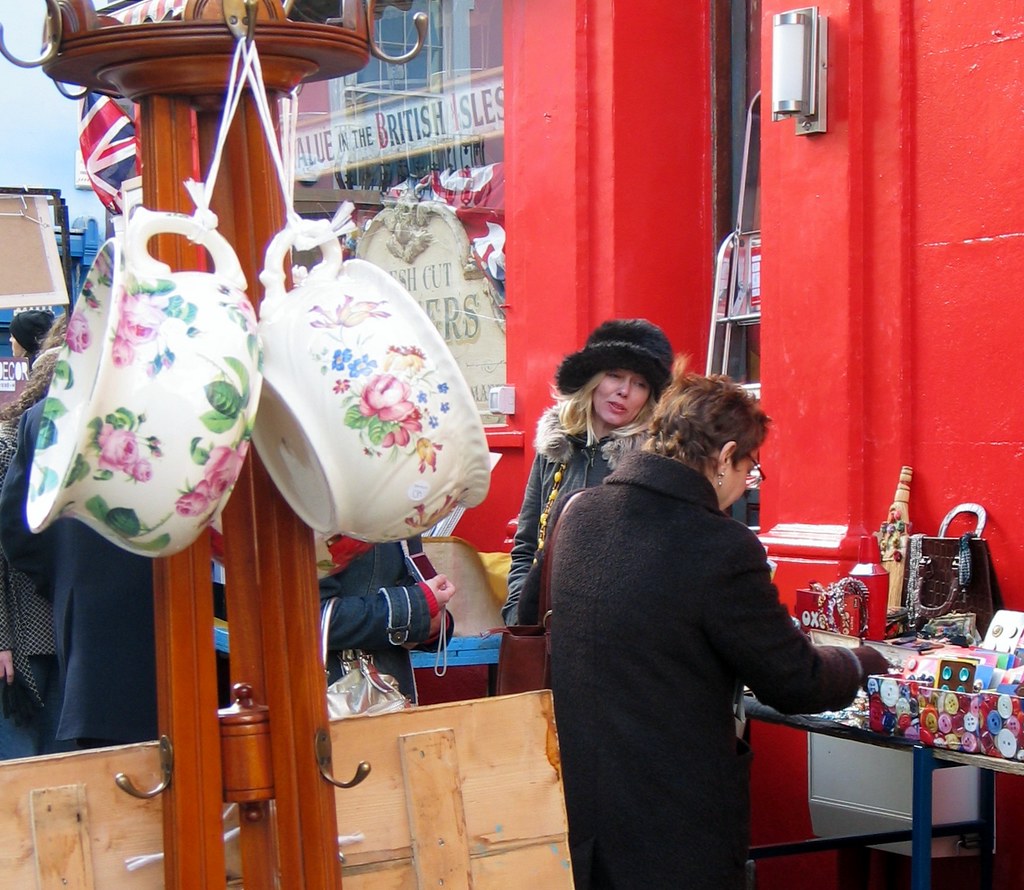
The Bermondsey Square antiques market opens at four in the morning on Fridays, in the small paved square between Bermondsey Street and Tower Bridge Road, in the borough of Southwark.
By five, perhaps forty dealers have set up. By six, perhaps seventy. By eight, the market is at its full size — about a hundred stalls — and by two in the afternoon it has packed up entirely and disappeared until the following Friday.
On the morning of May 8, 2026, a Pewter correspondent arrived at four-thirty with a small Maglite torch and a folding canvas bag, both of which are the standard equipment of the Bermondsey buyer. The torch is necessary. Until sunrise the square is genuinely dark, lit only by the strings of bulbs the dealers run from their own generators.
The Friday market at Bermondsey has been operating in some form since 1855, when it moved from its earlier site on the south bank. For most of its history, until 1995, the market enjoyed the curious legal status of market overt, under which a buyer in good faith between sunrise and sunset acquired clean title to a stolen object.
The repeal of the Sale of Goods (Amendment) Act in 1995 removed that protection. But the market's structure — the early hour, the cash trade, the absence of receipts — remained the same. The legal history shaped the market's character in a way that has outlasted the law itself.
The torchlit buying has a peculiar concentration. A dealer's table, lit by a single 60-watt bulb under a tarpaulin, holds perhaps forty pieces of small silver, three flatware sets, two snuffboxes, and a tray of mourning rings. A buyer plays the torch beam across the table, picking out a hallmark on a cigarette case, the chasing on a Georgian spoon, the rose-cut diamond in a Victorian brooch.
The hallmarks are what most of the early buyers come for. Bermondsey is, more than any other London market, a silver market. The dealers who set up before dawn deal in silver almost exclusively, and they know their assay marks. A Pewter correspondent watched a dealer from Hatton Garden examine three Georgian sauce ladles by torchlight in under ninety seconds and offer for one of them.
The ladle was London-marked, 1788, by the maker Hester Bateman, weighing about three ounces. The asking price was three hundred and sixty pounds. The dealer offered three hundred and twenty in cash. The seller accepted. The transaction was complete by five-forty-five.
Bateman pieces are common at Bermondsey, more common than they ought to be given the size of her workshop's output, and a serious silver collector learns to look for the indications of a forged or transposed mark. A genuine Bateman ladle will show the maker's mark in a particular orientation relative to the lion passant. Cyrus Peake has written elsewhere about the diagnostic minutiae of these marks.
The stalls along the eastern edge of the square deal in larger pieces — pewter chargers, brass candlesticks, the occasional small piece of furniture, a folding writing slope, a brass-bound mahogany box. The trade there is slower. The buyers come later.
One stall, kept by a dealer named Margaret Verstraete, sold only English pewter. She had laid out twenty-eight pieces in two rows on a folding table covered in baize. A 17th-century broad-rimmed plate by the maker Thomas Lawrence of London, marked with the rose-and-crown touch, was offered at eight hundred and forty pounds.
The plate had a small cleaned area in the centre, undisguised, which the dealer pointed out without prompting. The polish was old, the patina around it consistent. A Pewter correspondent examined it under torchlight for about three minutes and recorded the touch mark for later cross-reference against the Cotterell index.
The Cotterell index — Howard Cotterell's Old Pewter, Its Makers and Marks, first published 1929 — remains the working reference for English pewter touch marks. A good Bermondsey silver or pewter dealer keeps a battered copy under the table.
By seven the sun has cleared the rooflines and the torches are switched off. The market changes character. The dealers who came for the early silver trade begin to pack, replaced by sellers of jewellery, militaria, postcards, watches, and the occasional small painting.
The coffee at Bermondsey, served from a converted Citroën van parked at the south end, costs three pounds and is reliably good. A small bacon roll from the same van costs four. A serious buyer eats standing up, with the torch in one pocket and the cash in the other.
Bermondsey rewards the same sort of attention as Brimfield, but compressed in time and space. The whole market is perhaps the size of two American basketball courts. A buyer can walk it three times in an hour and learn it in a season.
The buyers themselves are a small and recurring cast. Hatton Garden silver dealers, Spitalfields auction-house scouts, a few collectors from Surrey and Kent who come up by the first train from London Bridge, and the occasional American or French dealer over for a week of market visits.
Trust at Bermondsey is built through repeat attendance. The first three or four Fridays a new buyer attends, the dealers will offer the higher tourist prices. By the sixth Friday, having seen the buyer pay cash, ask intelligent questions, and not return purchases, the prices begin to come down.
Verstraete sold the broad-rimmed Lawrence plate at seven-fifteen, to a private collector from Cambridge who paid in cash and carried the plate away in a piece of soft cloth he had brought with him. He had been negotiating, off and on, for forty minutes.
The market has shrunk over the last twenty years. In 1995 there were perhaps two hundred and fifty stalls on a busy Friday. In 2026 there are about a hundred. The reasons are familiar — internet sales, the rising cost of central London, the ageing of the dealer community — and Bermondsey now exists as a smaller, more concentrated, more knowledgeable market than it once was.
A Pewter correspondent bought nothing that morning. The point of the visit was the watching, and the watching was sufficient. The torch went back into the bag at sunrise, and the bag carried only a notebook home across Tower Bridge at eight-fifteen.