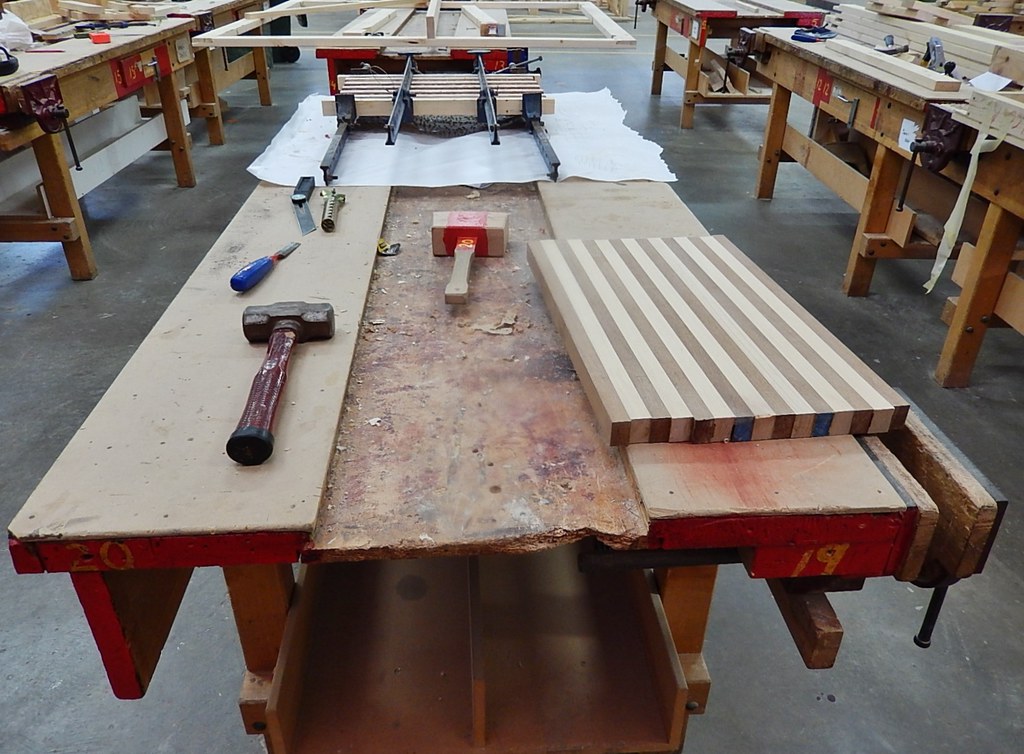
The basement workshop on Henderson Row in Edinburgh has been Iseabail McNair's working address since 1985. The bench at which she stands for six hours a day is older than that — it came with the lease, and the lease was old. The bench's surface, scarred and stained with forty years of her own work and an unknown number of years of her predecessor's, is the most-photographed object in the room.
The objects arranged on it are not many. McNair has resisted, over a long career, the temptation to acquire new tools. What is on the bench is what she uses. What she does not use, she does not own.
At the back of the bench, ranged against the wall, are seven glass bottles. Three contain shellac in graduating shades: pale blonde, button orange, and garnet. One contains pure ethanol. One contains a thinned mixture of shellac and ethanol she has pre-blended for the day's work. Two are empty, awaiting refill. The bottles are all old and unmatched, the survivors of a slow attrition.
To the right of the bottles, three small bowls hold pumice in three grades, from a coarse 4F to a fine FFF that resembles talc. McNair sources the pumice from a single supplier in Naples who has been in the trade since the 1950s. The supplier is now run by the grandson of the man who first sold to her teacher.
In front of the bowls sit four small tins, each containing a wadded-up cotton interior wrapped in a square of fine cotton fabric. These are her rubbers, the application tools of the French polisher's craft. McNair makes her own and replaces the cotton interiors every fortnight or so. The exterior cloth, washed and re-tied, may last six months.
A French polisher's rubber is the only specialised tool in the discipline. It is also, paradoxically, not buyable. The trade sells the components but no one sells a finished rubber, because a finished rubber is exactly the right size and weight and dampness for the person using it, and no one else.
McNair's are slightly smaller than the textbook size, because her hands are small and she works longer hours than most of her contemporaries. She tried, once, to use a larger rubber given to her by a visiting Belgian polisher, and she gave it back inside an hour. The hand has to know the tool, and the tool the hand.
Behind the rubbers, a small wooden rack holds eight brushes. Three are sable, two are squirrel, two are badger, one is hog bristle. They are used for fillers, for the initial spirit varnishing of complex carved surfaces, and for the small touch-ups that finish a piece. None of them are new. Two were her teacher's.
The teacher, Sandy Liddell, ran the same workshop McNair now runs. He took her on as an apprentice in October of 1985, when she was twenty-three and he was sixty-one. She worked under him for nine years before he retired and let her take over the lease. He died in 2004. His brushes she has kept in working order with the kind of care most polishers give to client pieces.
To the left of the bench, a small drawer pulled out and resting on its rails holds a dozen small tools that are not quite worth a place on the bench surface itself. A horn scraper for excess shellac. A pair of tweezers for picking foreign particles out of wet finish. Three small bottles of oil — almond, linseed, and one she calls walnut though it is in fact the contents of a 1972 French apothecary bottle whose label has faded past reading.
Above the bench, a fluorescent strip light supplemented by an angle-poise lamp in incandescent. McNair will not work under LED. She finds the colour rendering inadequate to the work, and she suspects, without being able to prove it, that the spectrum affects her perception of the shellac's depth as it builds.
The bench's surface itself, beyond the tools, holds whatever piece is being polished. On the morning of the interview, this was a small mahogany dressing-table top from a Georgian piece undergoing restoration in a workshop two streets away. It had been brought to her by a colleague who does the structural work but does not polish.
The collaboration is typical of the trade in Edinburgh, which is concentrated enough that the polishers know the cabinetmakers and the cabinetmakers know the polishers. A piece may pass through three or four hands before it leaves the city, each hand specialising in one stage of the work.
McNair takes on roughly forty pieces a year now, down from a peak in the late 1990s of perhaps a hundred. The reduction reflects partly her own pace, which has slowed slightly with age, and partly the contraction of the trade. Fewer pieces are being polished. More are being refinished, badly, by their owners.
She charges, for a piece of moderate size in good condition, between four hundred and twelve hundred pounds. She does not work cheaply, and she does not negotiate. Her clients are mostly trade — dealers and restorers who bring her work that is going to a private buyer who knows the difference.
The bench's emptiness, by the standard of most workshops, is intentional. McNair believes the polisher's tools should be visible and to hand. What is in a drawer is, in her experience, what gets forgotten. What is on the bench is what gets used.
She has not bought a new piece of equipment, by her count, since 2007, when the angle-poise lamp finally gave out and she replaced it. Before that, the last purchase was a small pair of tweezers in 1993. Both were necessities, not improvements.
Her advice to anyone wanting to learn the craft is the same advice Liddell gave her: find a polisher and watch them work for a week, before you spend any money on tools or materials. The work is mostly in the hand. The hand cannot be taught from a book. The hand can only be shown.
She has had two apprentices in her career, neither of whom stayed in the trade. The first left after a year for a job in conservation at the National Museum, which McNair regards as no loss to anyone. The second left after eighteen months to take over a family joinery business in Dundee. She does not currently have an apprentice and is not actively looking for one. The trade, she suspects, will outlive her by perhaps a generation, after which it will become a museum craft.
The bench will, presumably, be cleared and let to someone else when she finally stops. She has not made arrangements for the brushes.