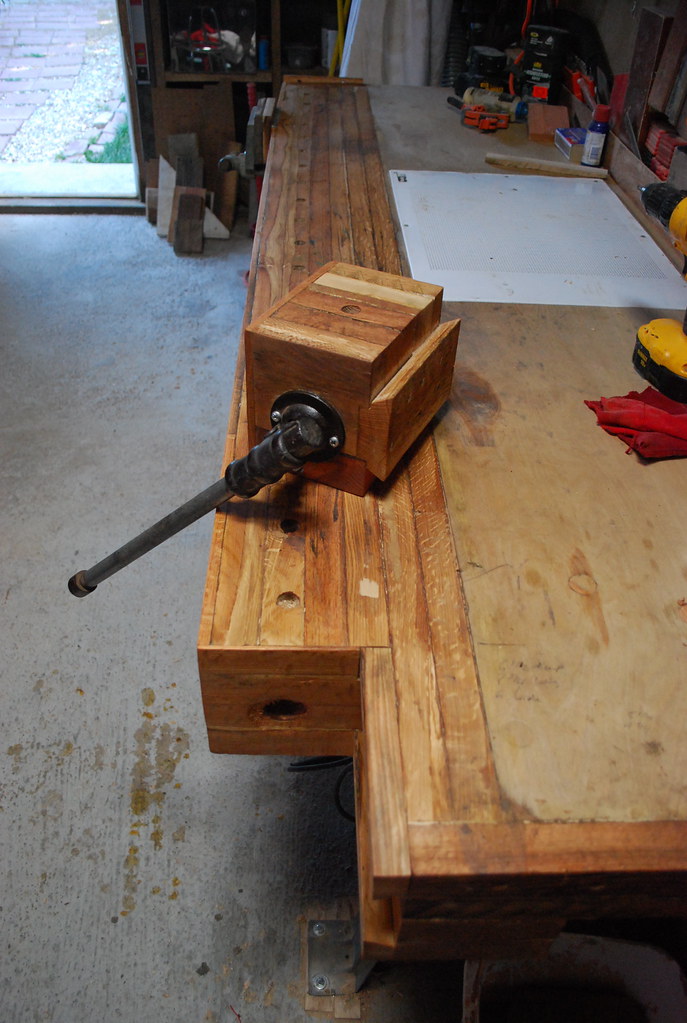
On a Tuesday morning in May of 2026, in a converted dairy barn in Brookfield, Vermont, the restorer Adelaide Lemoine stood beside the workbench she has used since 2003 and tried to remember exactly how much it had cost her to build. The figure she settled on was somewhere between thirty-two hundred and thirty-eight hundred dollars in 2003 money, plus six months of evenings and weekends.
The bench is roughly eight feet long, thirty inches deep, and thirty-six inches high. The top is two and a quarter inches of white oak, edge-glued from quarter-sawn boards she bought from a sawyer in Hardwick. The base is heavy stretcher construction in the same oak. There are two vises, one a Record 53E from the late 1970s salvaged from a closing workshop in Boston, the other a Lee Valley quick-release she bought new.
There are no fancy features. There is no tail vise, no sliding deadman, no built-in tool well. Lemoine considered all of these during the design stage and rejected each in turn as something she would not use.
What she does use is the dead-flat top, the immovable mass, the well-placed bench dog holes, and the height, which is exactly right for her at five-foot-six standing without shoes. The bench was designed around her body, which is what most published bench designs are not.
Over twenty-three years, the bench has supported the restoration of, by Lemoine's records, four hundred and eighteen pieces of furniture. Some were small — a Federal candle stand, a Shaker box. Some were large — an English breakfront that filled the workshop end to end. All of them were brought to the bench at some stage of the work.
The bench has been refinished once, in 2014, after the surface accumulated enough damage to interfere with the work. The refinishing took Lemoine a Saturday morning and a small jar of paste wax. The bench underneath the wear was, and is, in essentially the condition it left her assembly stand in 2003.
She has, with characteristic precision, calculated the bench's cost per square inch over its working life. The top is eight feet by thirty inches, which is 2,880 square inches. The original cost of about thirty-five hundred dollars works out to roughly a dollar twenty-one per square inch. Spread over twenty-three years, that is about five cents per square inch per year.
She has earned, over those twenty-three years, an amount she will not disclose precisely but which she allows is in the high six figures. The bench's contribution to that earning is impossible to separate from her own labour. But the bench made the labour possible, and a worse bench would have made it slower.
She has thought, occasionally, about the bench she would build now if she had to do it again. It would be, she believes, very similar. She would use the same wood, the same general design, possibly a slightly thicker top. She would not add a tail vise. She would, this time, build in a removable backstop for working on long pieces, which she has improvised for twenty-three years with a clamped board.
The bench's main competitor in the modern market is the imported European workbench, which can be bought ready-made for between fifteen hundred and four thousand dollars depending on size and features. Lemoine has examined several over the years and considers two or three of them genuinely usable. The Sjöbergs from Sweden she finds slightly light but well-made. The German Hofmann and Hammer benches she admires unreservedly. The cheaper Chinese imports she considers a false economy.
What the imported benches share, and what her own bench has, is the heavy top, the secure base, and the well-placed vises. What they generally lack is the customisation to the user's body, which can be added only by working at the bench and modifying it over the first year or two.
Lemoine's recommendation to younger restorers, when they ask, is the same as it has been for two decades: buy or build the best bench you can afford, even if it costs three months' rent, and then build the rest of your tool kit around it. The bench is the only tool that cannot be substituted for another. A poor chisel can be sharpened. A poor plane can be tuned or replaced. A poor bench, in daily use for decades, will limit every other piece of work that happens on it.
She has known restorers, particularly in their early years, who tried to do serious work on a flimsy folding workbench or a kitchen table. The work suffered. The work always suffers, because the bench is the reference surface against which everything else is measured, and a bench that flexes or wobbles or sits at the wrong height produces work that is slightly out of square in ways the maker cannot always identify.
The bench's second great virtue, after stability, is heft. Lemoine's weighs, by her estimate, about three hundred pounds. A pull saw at the leading edge produces no movement at all. A hand plane drawn the length of the bench produces no movement. A mallet blow on a chisel produces no movement. The mass absorbs the work and the work goes into the wood rather than into the bench's resonance.
Most consumer-grade benches weigh under a hundred pounds. They move under the work, and the work suffers correspondingly.
The third virtue is the height. Lemoine's bench is, as noted, exactly thirty-six inches at the top. This is wrong for a six-foot user and wrong for a five-foot user. It is right for her, and the rightness has spared her, over twenty-three years, a great deal of back pain. Conservators who work bent or reaching for decades develop chronic problems. Conservators who work at the right height generally do not.
She determined the right height by the simple test of standing relaxed with arms at her sides and measuring from the floor to the second knuckle of her closed fist. That measurement, plus an allowance for the work to be done above the bench surface rather than at it, gave her the thirty-six inches.
The bench has, in twenty-three years, required almost no maintenance beyond the one refinishing. The vises have been oiled occasionally. The dog holes have been kept clear. The legs have been levelled twice, after settling in the workshop's wood floor.
What it has not required is replacement, which is the deepest virtue of a properly-made tool. The bench will, Lemoine believes, outlast her working life. Her likely successor in the workshop, a young restorer from Burlington who has worked under her for the last three years, has already been told the bench stays with the building.
It is, on Lemoine's calculation, the single best purchase she has ever made for the trade. It cost her about a third of a year's expenses in 2003. It has paid that back, in usable working time, every year since.
She advises new restorers to spend the money. Or, better, to spend the six months.
Filed under