The icehouse stands about forty feet behind the main house, on the bank of a small unnamed brook that joins the West River two miles downstream. It was built in 1878 to hold winter ice for a Brattleboro hotel that closed in 1934.
Wendell Strauss bought the icehouse, and the house, in 1991. He spent six years restoring the shell of the icehouse with a local timber framer named Aaron Sharpless before he put a single tool inside.
He calls the result a museum, but it is not open to the public. About forty visitors a year are admitted, by letter, in groups of no more than four. There is no website. The address is on the letterhead Strauss uses for correspondence, and that is the entire publicity apparatus.
Inside the icehouse there are now 2,418 American carpenter's hand tools, arranged on white-oak racks that Sharpless built to Strauss's specifications between 1997 and 2001. The racks hold the tools by category and by maker.
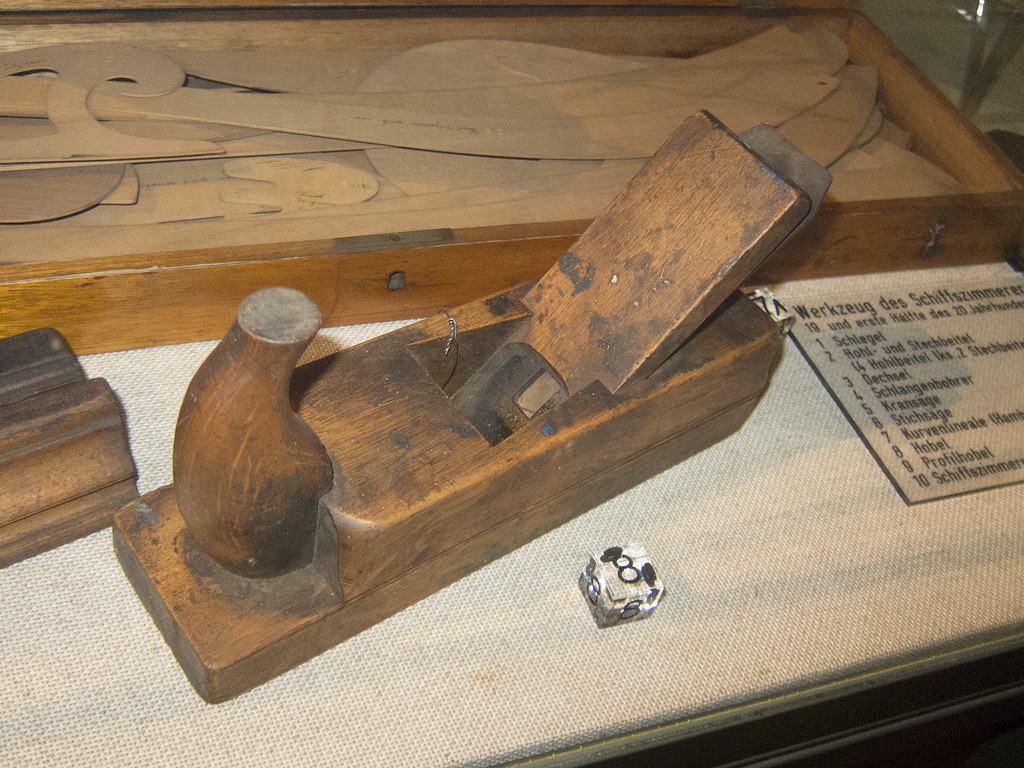
The heart of the collection is the hand planes. There are 1,107 of them. Of those, 743 are Stanley Rule and Level Company planes manufactured at the New Britain, Connecticut works between 1869 and 1942.
Strauss has a complete run of the Stanley Bedrock series in every size. He has eleven variations of the Stanley No. 1 smoothing plane, including a rare 1872 example with the original japanning intact on more than ninety percent of the body.
He paid sixteen thousand dollars for the 1872 No. 1 at a Brown Tool Auction in Pennsylvania in October 2018. It is the most expensive single object in the collection.
The Stanley planes occupy the west wall. The Sargent planes, of which Strauss has 198, occupy the south wall. The Union Manufacturing planes, which he considers the most underrated American line of the period, occupy a single tall rack near the door.
Above the door hangs a wooden-bodied moulding plane by John Veit of Philadelphia, dated 1842 by the toolmark on its toe. It was the first plane Strauss bought, in 1979, when he was a graduate student in mechanical engineering at Cornell.
He paid four dollars for it at an estate sale in Tompkins County. He says the plane taught him to look at toolmarks before anything else.
The collection also holds 312 wooden moulding planes, a complete set of Disston backsaws in original handles, four Goodell-Pratt rotary tools, and a small group of slick chisels from the Boston shipyards of the 1880s.
There is also a workbench. Strauss insists the workbench is part of the collection. It is a French-pattern bench built by the Vermont tool maker Christopher Schwarz in 2009, and it is used. Strauss sharpens, fettles, and occasionally restores planes on it.
If the tools were not being used, he said, they would be evidence of carpentry. Used, they are carpentry.
Strauss is sixty-eight. He spent thirty-four years as a mechanical engineer for a turbine manufacturer in Schenectady, New York. He retired in 2019 and now spends about thirty hours a week in the icehouse.
His method of acquisition has changed over the decades. In the 1980s and 1990s he bought at flea markets and from small estate sales. Since about 2005 he has worked almost exclusively through three specialist dealers and the major tool auctions.
He keeps a card for each object, written by hand on a 4-by-6 index card. The cards record the maker, the date of manufacture if known, the source, the date of acquisition, the price, and any conservation work he has done.
The cards are in a small oak file that Sharpless built for the purpose. There is no digital catalogue. The cards will outlast the spreadsheets, Strauss said.
His conservation philosophy is conservative. He cleans rust by hand with mineral spirits and 0000 steel wool, never by electrolysis. He waxes the cast iron with a museum-grade microcrystalline wax. He does not repaint, re-japan, or replace original parts.
The collection has been visited by curators from the Smithsonian, the Mercer Museum in Doylestown, Pennsylvania, and the Hancock Shaker Village. None of those visits has produced an acquisition arrangement, and Strauss has not solicited one.
He has, however, willed the icehouse and its contents to the Early American Industries Association, which has expressed an intention to keep the collection intact and open it to scholars by appointment. The arrangement was finalized in March 2024.
I do not want a wing of a museum, Strauss said. I want the tools to stay in this room. They were always meant for a room this size.
The icehouse is heated to a steady fifty-eight degrees Fahrenheit through the winter. The relative humidity is held at forty-five percent. The lighting is incandescent, on dimmers, never fluorescent. Strauss said the tools have not changed in eighteen years.