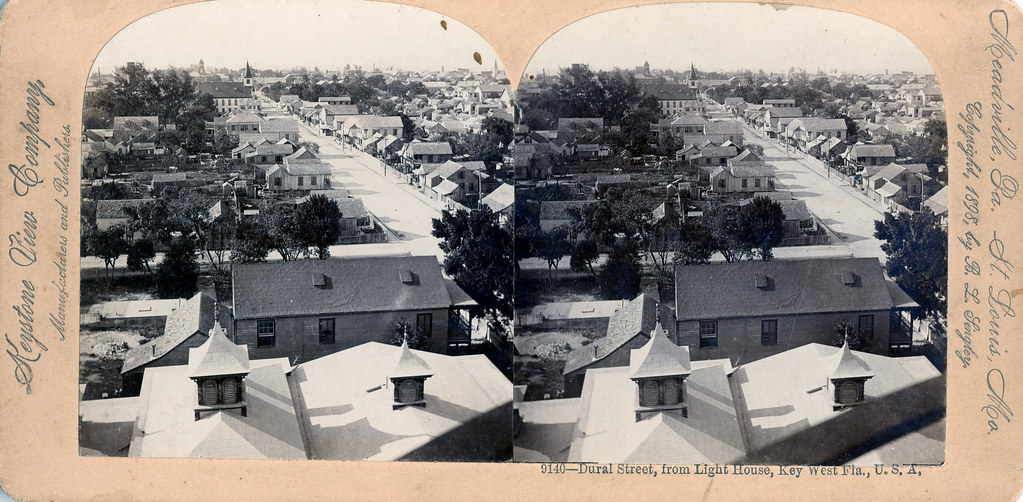
Marcus Olwen's collection of 8,432 stereograph cards is housed in a converted dairy barn at the end of a quarter-mile dirt drive outside Boonville, in Mendocino County, California. The barn has no street address. Olwen prefers it that way.
The cards are stored in a hundred and twelve oak boxes built to the standard 1880s stereograph dimension of seven inches by three and a half. The boxes were made over four years, between 1996 and 2000, by a furniture maker in Petaluma named Audrey Crane.
Each box holds eighty cards in acid-free interleaving paper, with a numbered card on top giving the subject group, the date range, and the name of any identified photographer. Olwen worked out the system in 1988 and has not changed it.
He began collecting in 1985, when he bought a single Underwood and Underwood stereograph of the Brooklyn Bridge at a yard sale in Sebastopol for fifty cents. He had never seen a stereograph before. He was twenty-six.
By 1990 he had a thousand cards. By 2000 he had four thousand. He passed eight thousand in late 2022 and has slowed his acquisition rate deliberately since.
The collection's center is American landscape stereography between 1865 and 1905. Olwen has 1,432 Yosemite cards, including a near-complete run of Carleton Watkins's Yosemite work from the early 1870s.
He has 612 cards of Yellowstone, including 88 by William Henry Jackson, of which 11 are from the 1871 Hayden Survey expedition. The Jackson Hayden cards are the most valuable single group in the collection.
He has 743 cards of the White Mountains of New Hampshire by Kilburn Brothers of Littleton, including a complete set of their 1872 Mount Washington series.
There is also a smaller specialty within the collection that Olwen built more recently — Japanese stereographs of Meiji-era street scenes, 1880 to 1905. He has 312 of those, most acquired from a dealer in San Francisco's Japantown between 2008 and 2019.
Olwen keeps three working stereoscopes on a long oak table in the center of the barn. One is a Holmes-pattern viewer made in 1873 by Joseph L. Bates of Boston. The second is a Underwood and Underwood Sun Sculpture viewer of about 1895.
The third is a Brewster-pattern box viewer made in London in the late 1850s, the oldest piece of equipment in the room. Olwen restored the leather of its hood in 2011 with the help of a bookbinder in Berkeley.
He uses all three regularly. A stereograph that has not been viewed is just a piece of cardboard, he said. You do not own a stereograph by owning the card. You own it by looking through the viewer.
His method of acquisition has shifted over four decades. In the 1980s and early 1990s he bought heavily at flea markets in northern California and southern Oregon. In the late 1990s he turned to specialty auctions, particularly Cowan's in Cincinnati.
Since about 2010 he has bought almost exclusively through three dealers — one in Maine, one in Vermont, and one in Devon, England. He has not been to a flea market in seven years.
The catalogue is a single bound ledger, written by hand in a hard-back accounts book Olwen bought at a stationer's in Healdsburg in 1986. He is now on his fourth ledger. The first three are kept on a shelf above the table.
There is also a database. Olwen built it in 2003 in a copy of FileMaker Pro that no longer runs on modern hardware. He prints out the database annually onto archival paper and keeps the printouts in a binder. He has not updated the digital file since 2017.
The ledger is the catalogue, he said. The database is a convenience that may not survive me.
Olwen is sixty-seven. He worked for thirty years as a wildlife biologist for the California Department of Fish and Wildlife and took early retirement in 2017. He now spends about twenty-five hours a week in the barn.
He has begun to think about the disposition of the collection. The Bancroft Library at Berkeley has expressed serious interest in the Watkins and Jackson groups. A regional historical society in Boonville has offered to take the rest.
Olwen would prefer the collection to stay together, but he is not certain that any single institution can take eighty-four hundred cards. He has not made a decision.
I have time, he said. The cards have been here forty years. They can be here for another five while I think.
On the day of the visit, he was indexing a small group of forty-two cards he had bought the previous month from the Devon dealer. They were English seaside scenes from the 1890s, a subject he does not collect, but the group had come bundled with a Kilburn he wanted. He was writing a new ledger entry by hand, in pencil, while the kettle boiled in the corner.