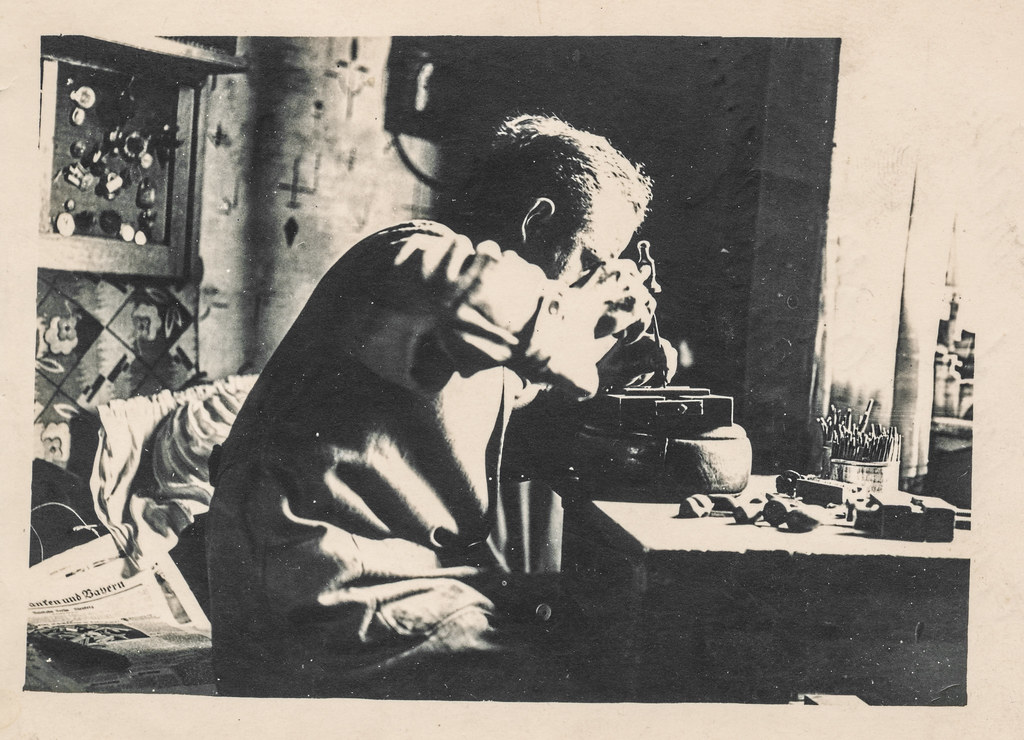
The shed sits on a granite outcrop above the harbour at Stonington, Maine. It was built in 1962 by Theodore Aroostook's father, Henrik, who used it first as a lobster-trap workshop and converted it to a clock shop in 1971 after his hands developed a tremor that disqualified him from rigging gear.
Theodore took over the shop in 2014, the year Henrik died. He was forty-three at the time and had been working alongside his father since 1989, when he came home from a half-finished engineering degree at the University of Maine to learn the trade properly.
On a clear Tuesday in early May, the shed smells of lemon oil and old brass. A nor'easter the previous week has left the wharf below littered with kelp. Theodore opens the door at seven in the morning and lets in the cold air for ten minutes before he lights the kerosene heater.
The bench is the original one Henrik built — a slab of cherry on iron legs, scarred by half a century of pivot work. Theodore has not refinished it. He says the marks are useful as a reference, which is partly a joke and partly the truth.
On the bench this morning is a Seth Thomas adamantine mantel clock, manufactured in Thomaston, Connecticut, in 1907. It belongs to a summer resident named Frances Wickenden whose family has owned a house on Crotch Island since 1924. The clock has not run since 1991.
Theodore has the movement out of the case. The plates are brass, the wheels are brass, the pivots are tempered steel, and the whole assembly sits in a Bergeon holding block clamped to the bench at a slight angle.
He works under a 10X loupe screwed into a wooden frame he calls the bridge, which he can swing in and out of position with his left hand while the right hand stays on the work. The bridge was his father's design.
The clock's problem is straightforward and tedious. The pivots — small steel stubs at the end of each wheel arbor — have worn into the brass bushings on the plates, and the resulting slop has thrown the gear train out of mesh. Five bushings need replacing.
He has a drawer of bushings sorted by inner diameter, ranging from 0.6 millimetres to 2.4. He selects three at the small end and two at the medium, and he sets them in a small porcelain dish to keep them from rolling off the bench.
Bushing replacement is done with a Bergeon bushing tool, a hand-operated press he has owned since 1996. The old bushing is reamed out, the hole is enlarged to the new bushing's outer diameter, and the new bushing is pressed in with a single firm stroke of the lever.
He breaks at nine-thirty for coffee, which he drinks from a thermos his sister gave him in 2003. She lives in Portland now and visits twice a year. The thermos has outlasted three relationships, he says, which is the kind of remark he makes only to people he likes.
By eleven the bushings are in. He cleans each pivot with a charcoal stick — an actual stick of compressed charcoal, the same kind clockmakers have used since the 18th century — and inspects them under the loupe for burrs.
Two pivots are slightly out of true. He sets them in a Jacot tool, a small lathe-like fixture with hardened beds, and burnishes them with a flat steel file held at a precise angle. The action is hypnotic. He has done it tens of thousands of times.
His father's loupe, which sits in a drawer to the left of the bench, has Henrik's initials scratched into the brass rim. Theodore uses it only on jobs that came from clients Henrik knew personally. Frances Wickenden's clock qualifies. Her father commissioned its first cleaning in 1979.
The backlog of work in the shop is, by Theodore's own count, about thirty-one clocks deep. Some have been there since the 1990s. A few belong to clients who have since died, and Theodore has not had the heart to mail the executors with a final bill.
He works on a strict order: paid deposit, in the door, on the queue. He charges a flat one hundred and fifteen dollars to assess a movement and provide a written estimate, which he writes in pencil on a yellow legal pad and photocopies at the library.
By two in the afternoon the Seth Thomas movement is reassembled, oiled with a single drop of Mobius 8000 at each pivot, and running on the test stand. The pendulum swings a hair fast. He will adjust the rating nut on Wednesday.
He covers the bench with a piece of unbleached cotton at four o'clock and walks down the hill to the post office before it closes. There is a package waiting from a parts supplier in Pennsylvania. He carries it home under his arm and does not open it until morning.
The harbour is quiet. The lobster boats are in for the day. Theodore stands on the steps of the post office for a moment and watches a herring gull working a piling. He says aloud to no one in particular that the clock will be ready by Friday.
Frances Wickenden is in no hurry. She told him in March that she would rather have it right than have it soon. This is, in Theodore's experience, the kind of remark that distinguishes the good clients from the rest.