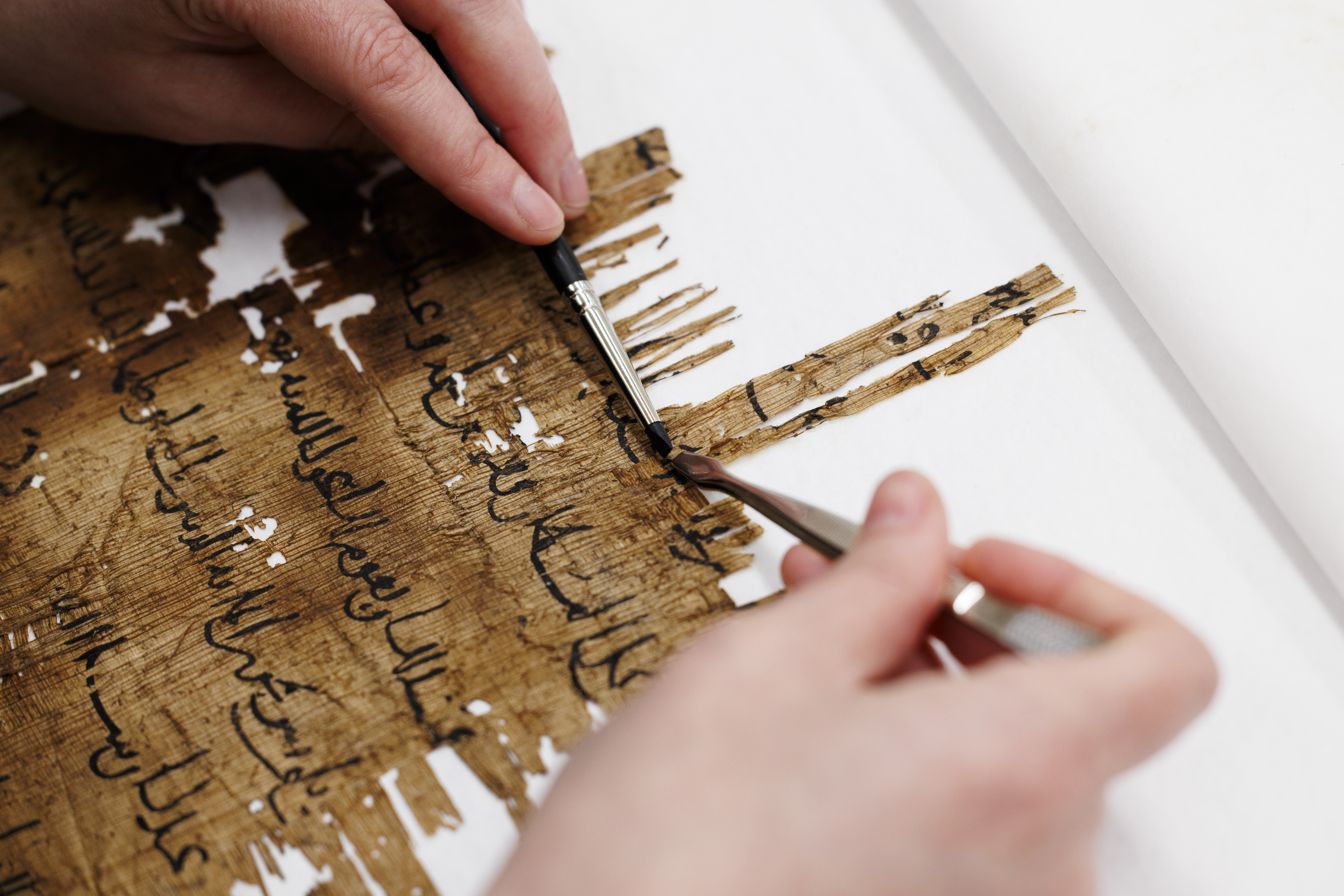
Una MacBeath works at the top of a stone tenement in Edinburgh's Stockbridge district, three flights up a stair that smells in equal parts of old paint and chip shop. The flat below hers belongs to a retired sheriff. She has never met him.
Her studio is a converted bedroom with two north-facing skylights, a long oak worktable, a sink fitted with a deionised-water tap, and a large light table that she built from a sheet of acrylic and four bicycle-shop lamps in 2011.
She trained at Camberwell School of Art in London between 1996 and 1999 and has worked privately in Edinburgh since 2004, taking commissions from the National Library of Scotland, the Mitchell Library in Glasgow, and a small but steady clientele of private collectors and family historians.
On the Wednesday in question, the thirteenth of May, she has on her table a sheriff's ledger from Inverness-shire, dated 1842 to 1849, with brown leather covers and a marbled endpaper that has gone the colour of dried blood. The ledger was found in a flooded outbuilding in Beauly in February.
The owner, a man named Calum Fraser who inherited the property from a great-aunt, brought the ledger to MacBeath in March in a cardboard box lined with newspaper. The pages were stuck together in clumps. The leather was sprouting white mould.
She quarantined the volume in a chest freezer for ten days at minus twenty-five degrees Celsius to kill the mould, then transferred it to a sealed plastic crate with silica desiccant for a month to dry it slowly. Slow drying matters, she says. Fast drying buckles the paper into shapes that cannot be undone.
By May the ledger is dry enough to disbind. She works under the skylights at the long table, with a scalpel, a bone folder, and a small vacuum that has a HEPA filter. She wears nitrile gloves, but only when she handles the leather.
Disbinding requires removing the sewing threads from the spine — in this case linen thread that has rotted to powder — and lifting each gathering free of the boards. The gatherings are folded sheets of laid paper, four bifolia each, hand-numbered in iron-gall ink that has bitten through the page in places.
She sets each gathering on a sheet of Mylar and photographs it from above with a Nikon mounted on a copy stand. The photographs go into a folder on her laptop labelled with the date, the owner's name, and the ledger's date range. She has done this for every job since 2008.
The pages need washing. Iron-gall ink reacts to water in unpredictable ways, so MacBeath tests a small corner of an interior page first by drawing a damp brush across it and watching for any movement of pigment. The ink holds. She decides she can proceed.
She washes the pages one at a time in a shallow bath of deionised water tempered to twenty degrees Celsius, with a small amount of calcium hydroxide added to neutralise residual acidity. The bath is the kind of plastic developing tray that photographers used in the 1980s. She bought four of them at a closing-down sale in 2002.
Each page floats for fifteen minutes. The water around it turns pale brown — a tea-coloured tannin leach that is harmless in moderation and indicates the page is releasing the acidic compounds that have been embrittling it for nearly two centuries.
She lifts each page from the bath on a sheet of Reemay polyester support and lays it flat on a stack of blotting paper. The blotters are changed twice. The page dries between two more sheets of Reemay under a sheet of plate glass weighted with a marble paperweight.
The work is repetitive. MacBeath does not find it boring. She listens to BBC Radio 3 at low volume and works through three or four pages an hour, which means the ledger will take her about three weeks to wash at the current pace.
She breaks for tea at eleven and again at three. She drinks her tea from a porcelain mug a friend made for her in 2017. The mug has a chip on the rim that she has never sanded down.
The afternoon's washing finishes at five. She covers the worktable with a length of unbleached cotton and switches off the skylight blinds. The ledger pages, drying between blotters, occupy most of the floor space along the south wall.
Calum Fraser is patient. He has told her that the ledger does not need to be back in Inverness until autumn, which gives her time to wash, deacidify, mend any tears with Japanese tissue and wheat-starch paste, and resew the bindings into the original leather covers if the covers can be salvaged.
She is not yet certain the covers can be salvaged. The leather has corium rot in two of the four corners, and the boards beneath are warped. She will make that decision in June. She tells clients, in writing, when she has made it.
She locks the studio at six and walks down the stairs past the retired sheriff's door. She has no idea what he does with his days. He has no idea what she does with hers. This is, in her experience, the right arrangement for a tenement.