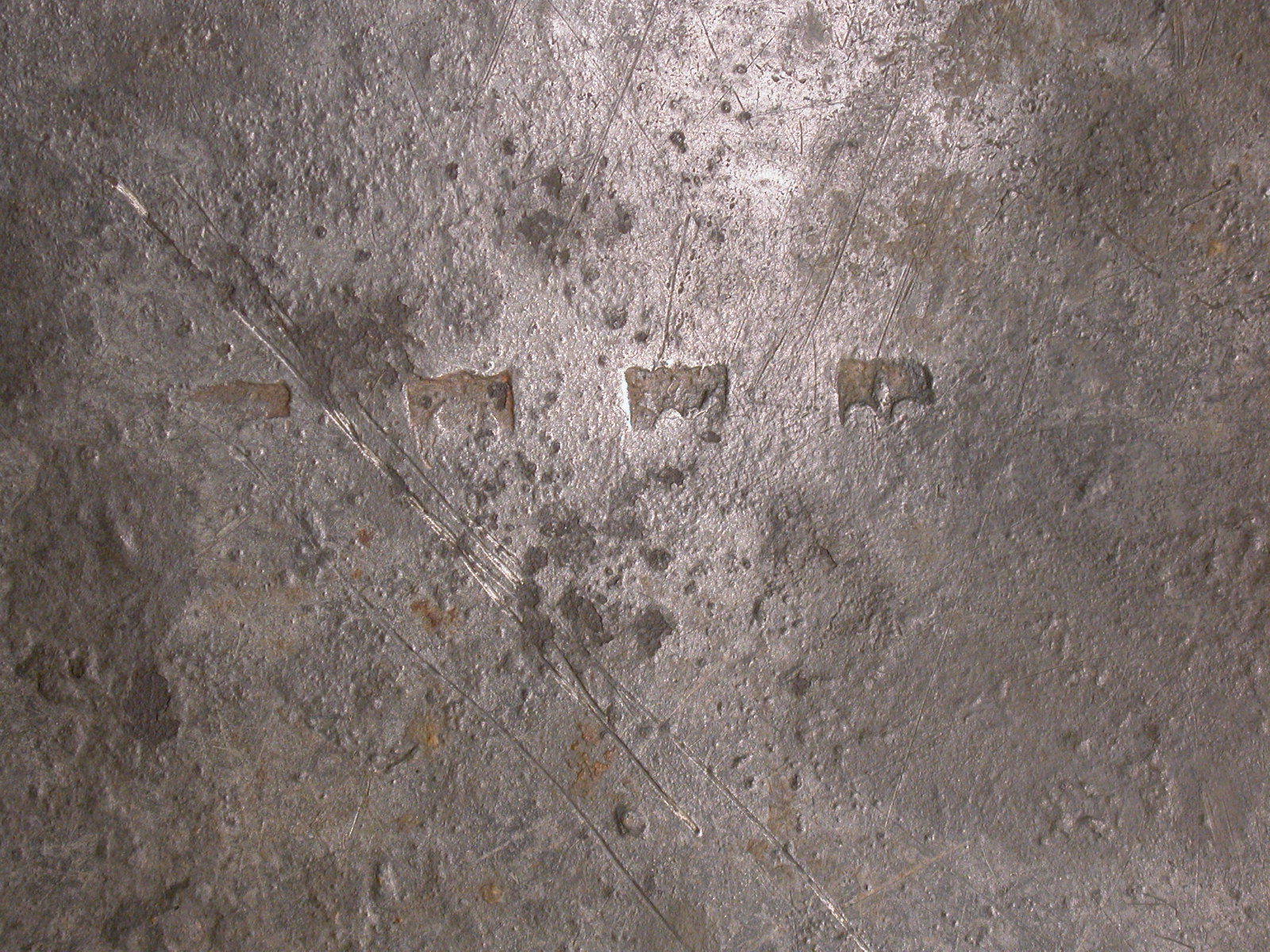
The London Pewterers' Company kept a touchplate at Pewterers' Hall on Lime Street from 1668 until the Hall was destroyed in the Blitz in 1940. The touchplate was a flat sheet of pewter on which each newly admitted master struck his personal mark, a touch, alongside those of the men who had come before him.
Five plates survived. Two are now in the possession of the Worshipful Company of Pewterers; three are in regional collections. The plates carry roughly one thousand touches, and they remain the single most important reference for English pewter made between the Restoration and the early industrial period.
An eighteenth-century pewter tankard, properly marked, will carry several distinct stamps. The most important is the touch itself — the maker's personal device, usually a small picture or monogram inside a shaped cartouche.
Touches were drawn from a wide vocabulary. A lion rampant, a sheaf of wheat, a hand holding a hammer, a beehive, a wheatsheaf with the maker's initials beneath — the iconography is dense and, to anyone unfamiliar with it, almost arbitrary.
Beside the touch, a competent maker would strike one or more quality marks. The crowned X is the most common; it indicates that the metal is hard pewter, the alloy known as plate metal, which contains a higher proportion of tin and less lead than common pewter.
The hallmark-style stamps, sometimes four small marks in imitation of silver hallmarks, were used by some makers from about 1690 onward. They had no legal force — the Pewterers' Company never had statutory powers to assay — but they served as a kind of marketing.
The customer who could read a silver hallmark, the thinking went, could be reassured by something that looked similar on his pewter flagon. The conceit was not subtle, and the Company periodically tried to stop it. The stamps persisted.
Ownership marks are a separate category. A monogram or a coat of arms, often touchmarked into the lid of a tankard or the rim of a plate, was added by the buyer or by an engraver shortly after purchase.
Inn marks are the most interesting subset of ownership marks. A small punch reading WB on a tankard from a Devon estate sale this past March almost certainly stands for the White Bear, an inn at Honiton that operated from 1734 until the 1880s.
Eighteenth-century English pewter falls into three broad regional traditions. London is the largest. Bristol is the second, with a distinctive flat-handled tankard form. The North, centred on Wigan and York, produced harder, plainer work.
Wigan pewter is sometimes the most rewarding for the patient collector. The marks are less well documented, the pieces tend to be less expensive, and the metal — Wigan was close to the Cornish tin trade by way of the Mersey — was often of high quality.
A Wigan baluster measure from about 1740, picked up at a small fair in Lancaster in February, carried a touch identified as that of John Wright the elder, a maker who operated from 1718 to 1751 and whose work appears on the Wigan touchplate.
Identifying a touch is rarely a matter of consulting one book. The standard reference is Cotterell's Old Pewter, Its Makers and Marks, first published in 1929 and still in print in facsimile. Cotterell catalogued some 5,800 marks; the book is indispensable.
Cotterell is supplemented by the Society of Pewter Collectors' journal, which has appeared since 1965 and has published research on individual makers, regional traditions, and specific touchplates.
The plate metal mark, the crowned X, is sometimes faint. Pewter is a soft alloy, and the marks wear with use. A tankard that has been polished weekly for two hundred years may have its touches almost obliterated.
When a touch has been worn away, the form of the piece is the next best clue. A tulip-shaped tankard with a flat lid and a thumb-piece in the shape of an erect ball can be dated to about 1735 to 1760 even without a mark.
Cyrus Peake keeps a sheet of butcher's paper pinned to the wall above his bench, on which he sketches the thumb-pieces, lids, and handles of any piece that passes through. The sheet, now four years deep, has become a working typology.
Forgery of touch marks is rare. Pewter is soft enough that a forged mark looks freshly struck, and the surface around it lacks the small darkening — the patina the trade calls tarnish bloom — that builds up around an old mark over decades.
A more common problem is the recast. A piece broken or melted and recast in the eighteenth century itself, using the original alloy, may carry a fresh touch struck by the same maker. These are not forgeries; they are honest repairs by their own standards.
The honest collector accepts that pewter, more than silver, was a working metal. Most of what survives is what was used hardest — the inns, the kitchens, the ships. Untouched parlour pieces are the exception.
Peake's wall holds a small framed photograph of the London touchplate, taken before the war. He looks at it sometimes, before he picks up the loupe for the next piece on the bench.