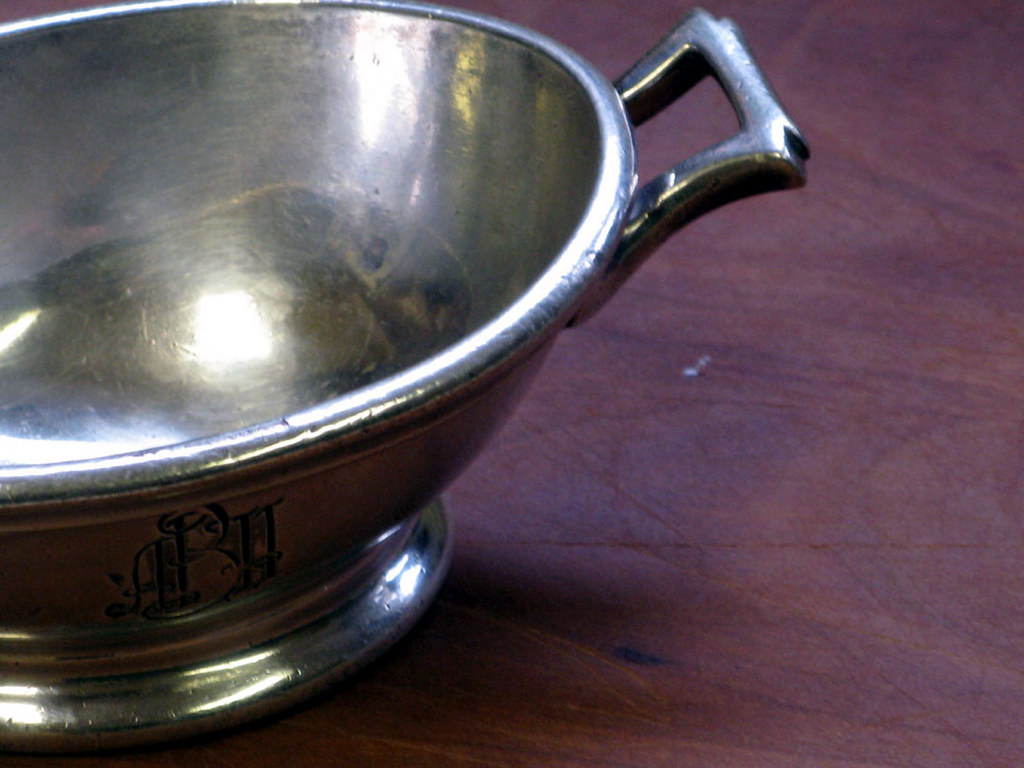
An Edwardian tea pot from a Bristol estate sale, picked up for twenty-two pounds in February, carried the impressed letters EPNS beneath the maker's mark of James Dixon & Sons. The four letters do not denote silver, and yet the piece is worth more than its weight in silver would suggest, and considerably more than the seller realised.
Electroplating was developed in Birmingham in the late 1830s by the Elkington brothers, who took out the foundational patent in 1840. The process — depositing a layer of silver onto a base metal by electrolysis — transformed the silver trade within a generation.
EPNS stands for Electro-Plated Nickel Silver. The acronym is precise: the deposited surface is silver, but the underlying body is nickel silver, an alloy of copper, nickel, and zinc that has no actual silver in it.
EPC, less common, stands for Electro-Plated Copper. The plating method is the same; the body is straight copper. EPC pieces are typically older or cheaper than EPNS; nickel silver became the dominant base metal by the 1860s because it tarnishes less obviously where the plating wears through.
The presence of the EPNS or EPC mark settles the question of whether a piece is silver or plated, but the absence of either mark does not mean a piece is silver. Many plated pieces from the late nineteenth century carry only a maker's mark and pattern number.
The four pseudo-hallmarks adopted by some electroplaters in the 1870s and 1880s — four small punches in a row, in imitation of genuine silver hallmarks — were a source of considerable confusion at the time and remain so today.
These pseudo-hallmarks have no legal force. The Hallmarking Act of 1973 specifically prohibits marks that might be mistaken for genuine hallmarks, but the prohibition was not retrospective, and Victorian and Edwardian pieces with imitation hallmarks remain in circulation.
Distinguishing a genuine hallmark from a pseudo-hallmark is usually straightforward for a competent eye. The genuine hallmark always includes a town mark (the lion-and-castle for Sheffield, the anchor for Birmingham, the leopard's head for London) and a standard mark (the lion passant for sterling).
Pseudo-hallmarks substitute decorative symbols for these. A common Victorian set used a small crown, a small star, a small shield, and a small horse, in arbitrary combination. None of these has any equivalent in the genuine hallmarking system.
Old Sheffield Plate, the predecessor to electroplate, is a separate category requiring its own attention. Old Sheffield Plate was made by fusing a thin sheet of silver to a copper ingot and then rolling the two together into a single laminated sheet, which could be worked like solid silver.
The technique was developed in Sheffield in the 1740s by Thomas Boulsover and dominated the silver-imitating trade until electroplating displaced it. Old Sheffield Plate marks are distinct from electroplate marks and substantially older — generally 1760s to 1830s.
An Old Sheffield Plate marker would often use his initials in a small punch resembling a silver maker's mark, but Sheffield Plate was prohibited by law from carrying marks that imitated the full silver hallmark sequence. The makers got around this by using their initials with various decorative additions.
Where the silver plating on Old Sheffield Plate wears through, the underlying copper shows as a warm pink — the trade term is bleeding. A bleeding edge on a candlestick or salver is a near-certain sign of Old Sheffield Plate.
Electroplate, by contrast, bleeds white or grey where the plating wears through, because the underlying nickel silver is a paler colour. The character of the bleeding is one of the quickest tests for distinguishing the two technologies.
James Dixon & Sons, of Sheffield, was one of the major nineteenth-century plating firms. Founded in 1806, the firm produced both Old Sheffield Plate and, from the 1840s, electroplate. Its mark is consistent: a small bugle horn within a circle, with the words DIXON or JD & S accompanying.
Elkington's own marks are more elaborate. The firm used a date-letter system from 1841 to 1864, then a numeric date code in three figures from 1865 onward. An Elkington piece marked with the three figures 12 K is from the year 1885; the K is a month code (October).
Mappin & Webb, another major firm, used a small bell mark on its later electroplate. Walker & Hall used a five-pointed star with the letters W & H. Each major firm developed its own house mark, and the maker's mark on a plated piece is often the most useful identifier.
The collecting market for electroplate has fluctuated. Edwardian electroplate, abundant after a century of accumulation, was undervalued through most of the twentieth century. Prices rose modestly in the 2010s and have stabilised since.
A good Edwardian electroplate tea service, with matching pot, milk jug, sugar bowl, and tray, by a recognised maker, in usable condition, will sell at a small London auction in 2026 for roughly five hundred to twelve hundred pounds. The Bristol pot was the start of such a set; the rest may yet turn up.
Cyrus Peake notes that the trade often dismisses electroplate as a poor cousin of silver. The dismissal is unfair. Good electroplate, well-designed and well-made, is worth keeping; bad solid silver, badly designed, is not made better by its material.
The Bristol pot has been polished, lightly, with a clean cotton cloth and a small amount of long-chain plate polish. It now sits on a tray on the sideboard, in use on Sunday afternoons.