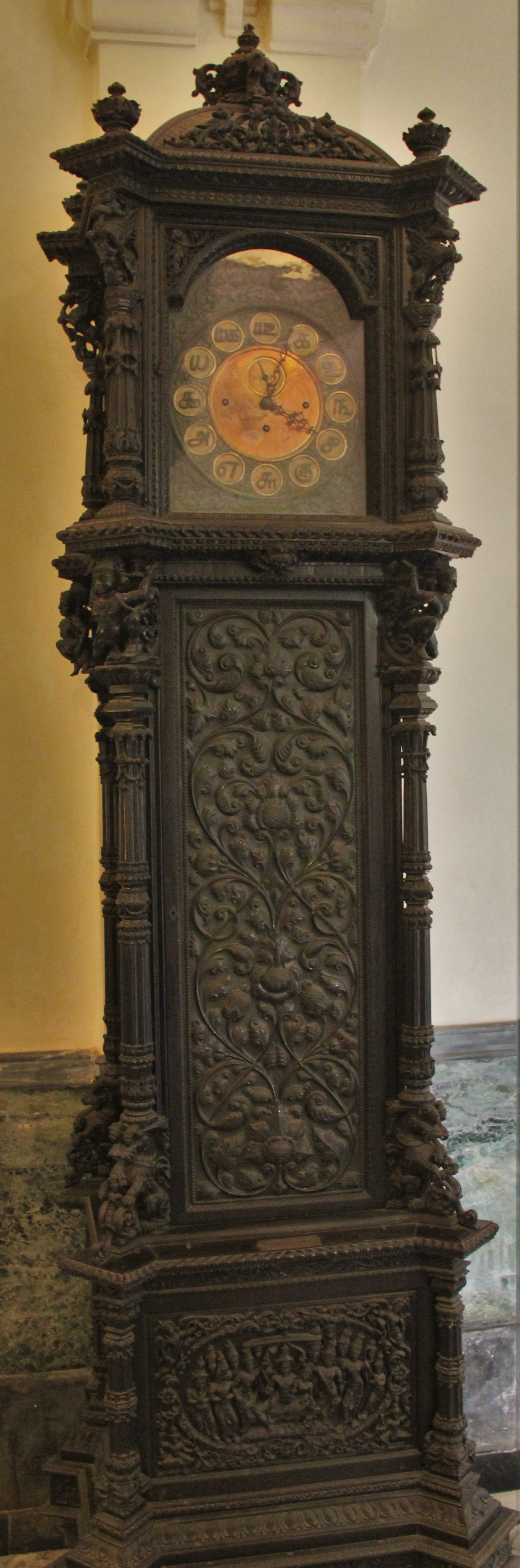
An eight-day longcase clock arrived at Ellis Mauro's Berlin workshop in March, sent down from a private estate in Lübeck. The brass dial bore the engraved name Thomas Mudge, London; the movement, on inspection, told a more complicated story.
Longcase clocks — the tall floor-standing clocks called grandfathers in casual usage — were the principal domestic timekeepers of the British and Northern European middle classes from about 1660 until the spring-driven mantel clock began to displace them in the 1820s.
The dial is the part the original owner saw daily. It is also the part most often signed. A name engraved in script across the bottom of the dial chapter ring, or at the centre of an applied silvered disc, is the obvious starting point for identification.
The engraved name is not always the name of the man who made the clock. By the mid-eighteenth century, the longcase clock trade was substantially specialised, with dialmakers, casemakers, and movement-makers supplying their work to retailers who put their own name on the dial.
A clock signed Thomas Mudge, London on the dial, with no other inscription, might have been entirely made by Mudge — who was one of the most respected London horologists of the eighteenth century — or it might have been retailed by Mudge from components supplied by Birmingham or Lancashire workshops.
The movement carries the more honest record. Behind the dial, on the back plate of the movement, the actual maker often punched or engraved his name, sometimes with a serial number, sometimes with a date.
The Lübeck clock had the name Mudge on the dial, but on the back plate of the movement was the engraved inscription Robt. Fearnley, Wakefield, 1782. Fearnley was a Yorkshire movement-maker who supplied a number of London retailers, including Mudge's firm.
Fearnley's name does not diminish the clock. His work was competent and the movement is original to the case, which is itself a handsome mahogany piece with brass-mounted columns of probable London origin. The clock is what it has always been: a London-retailed, Yorkshire-built, mahogany-cased longcase clock of 1782, in good working order after some attention.
Identifying the maker from the back plate requires removing the dial, which requires removing the hood from the case and then unscrewing the dial from the front plate. This is delicate work; it should not be attempted casually.
An owner who wants to know more about a longcase clock without taking it apart has several other options. The dial style itself is highly diagnostic.
Brass dials with applied silvered chapter rings, cast spandrels at the corners, and a separately applied silvered disc bearing the maker's name are typical of the period from about 1680 to about 1770. After 1770, painted dials — known as white dials or sometimes Birmingham dials — became increasingly common.
The painted dial was a Birmingham invention of the early 1770s, developed by Osborne and Wilson of Birmingham and patented in 1772. By 1790 it had displaced the brass dial in most of the provincial trade.
Painted dials carry their own marks. On the back of the dial, painted in red or black, the dialmaker's name often appears: Wilson, Osborne, Walker and Hughes, Finnemore, Wright. These names identify the dial supplier, not the clockmaker.
A painted dial signed on the front with a clockmaker's name and on the back with a dialmaker's name is the normal late-eighteenth-century arrangement. The two names do not conflict; they record the division of labour.
Movement features also help dating. A clock with a 30-hour movement (wound daily) and a one-handed dial is most likely pre-1730. A clock with an 8-day movement (wound weekly), a brass dial, and a seconds dial is likely 1700 to 1770. A clock with an 8-day movement and a painted moonphase dial is likely 1780 to 1830.
The seconds dial, a small subsidiary dial at the top of the main dial showing seconds, was a refinement of the 1690s that became standard on quality longcase work by 1720. Its presence is a marker of quality.
The strike train — the mechanism that strikes the hours on a bell — varies in arrangement. The earlier countwheel strike, used until about 1720, struck the hours but did not coordinate strictly with the hands. The rack-and-snail strike, developed by Thomas Tompion in the 1670s and adopted widely after about 1700, coordinated the strike with the hour position.
Tompion himself, whose clocks are now museum pieces, signed his work clearly: Tho. Tompion, London, often with a serial number. Tompion's serial numbers run from 1 (around 1670) to about 5,500 (around 1713, the year of his death).
An original Tompion longcase clock at auction in 2026 would be expected to make between two and five hundred thousand pounds, depending on condition and case. The number of genuine Tompions is small, perhaps three hundred surviving; the number of clocks falsely signed Tho. Tompion is considerably larger.
Forgery of clockmaker signatures was common in the nineteenth century. A skilful engraver could add a Tompion or a Graham signature to a competent provincial movement and substantially increase its market value. The forgeries are sometimes betrayed by the engraving style, which usually post-dates the signed maker by several decades.
The longcase clock trade collapsed in the 1830s under competition from American shelf clocks and French mantel clocks. By 1850, few longcase clocks were being made; by 1880, none of consequence were.
Survivors from the great period — the century from 1730 to 1830 — remain numerous, and a competent eight-day longcase clock of provincial English manufacture in working order can still be bought at country auctions for under two thousand pounds. The Lübeck clock, repaired and regulated, will be returned to its German owner in July.
Ellis Mauro closes the back of the movement, replaces the dial, and slides the hood back into position. The clock, set running, gives a slow audible tick across the workshop. It has been silent for forty years.