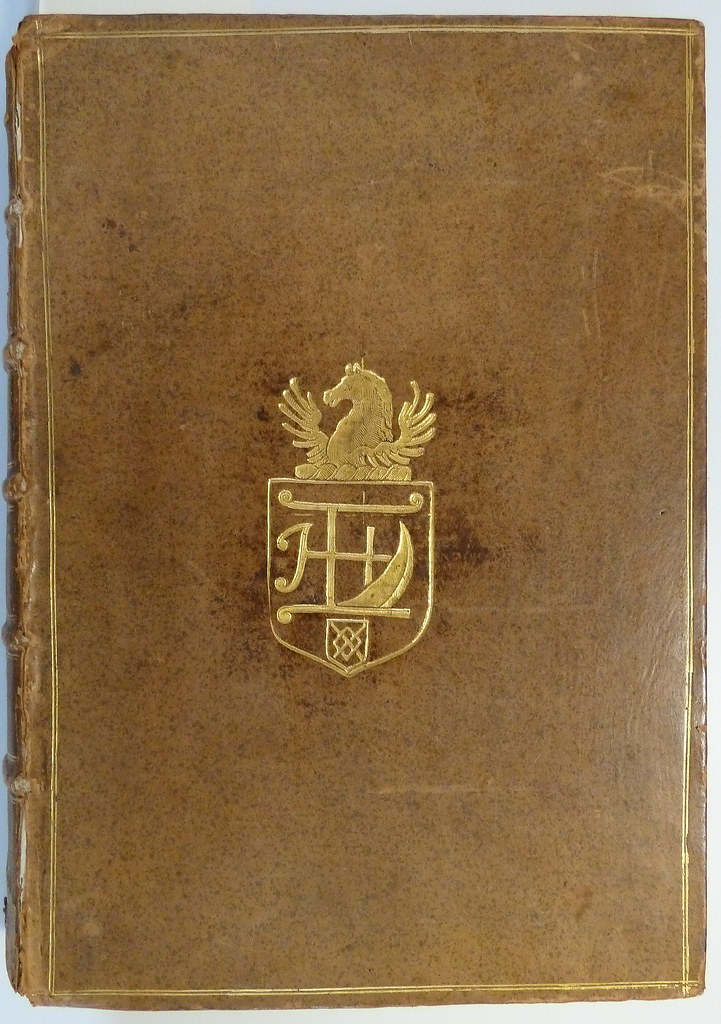
The library belongs to a retired classics professor named Margaret Estabrook, and it occupies what was once the assembly hall of a one-room schoolhouse in Tamworth, New Hampshire. The schoolhouse was built in 1873, closed in 1947, and converted to a house in 1979. Estabrook bought it in 1996 and has been moving her books in ever since.
There are now approximately 2,800 volumes. The oldest is a 1602 Estienne edition of Plutarch's Moralia, in Greek, that Estabrook inherited from her dissertation advisor. The most fragile is a set of mid-nineteenth-century pamphlets on the abolitionist movement in northern New England, bound in their original paper wrappers, that she found at a barn sale in 2003.
Since January 2018, Estabrook has kept a daily logbook of the temperature and relative humidity in the library. The logbook is a plain bound notebook from a stationer in Concord, and it now runs to four volumes. At seven in the morning each day, she reads two hygrometers — one on the south wall, one on the north — and writes down both readings.
She is not a conservator. She is a reader of books who decided, at sixty-two, that she wanted to know what her house was doing to her library.
What the logbook shows is unsurprising and, in its way, alarming. The interior relative humidity in Tamworth, in a wood-framed house with forced-air heating and no humidification, swings from a low of 19 percent in late January to a high of 78 percent in mid-July. The temperature swings less, from about 60 degrees Fahrenheit in winter to 76 in summer, because Estabrook does not air-condition aggressively.
The conservator's preferred range for paper-based collections is roughly 30 to 50 percent relative humidity, with daily fluctuations of less than 5 percent and seasonal drift of less than 10 percent. Estabrook's house, before she began to intervene, was failing on every measure.
The first thing she did, in early 2018, was give up on the basement. The basement was the obvious place for overflow shelving. It was also, on her hygrometer, between 78 and 88 percent humidity year-round, with periodic spikes during spring snowmelt that touched 95.
She moved every book out of the basement over six weekends. Several volumes had already developed faint foxing on the page edges, and three had mild mold blooms on the cloth bindings that required isolation and brushing. The mold-affected books were quarantined in paper bags in a dry shed for two months before being cleaned with a soft brush and a HEPA-vacuum technique she learned from a video produced by the Northeast Document Conservation Center in Andover, Massachusetts.
The second thing she did was install two whole-house humidifiers on the furnace ductwork. The humidifiers run from late October to mid-April. They raise the winter low from 19 percent to a steady 38 to 42 percent. This is still below the conservator's ideal of 45 to 50, but it is well within the range that arrests the worst damage. Below 30 percent, leather bindings desiccate and parchment cockles. Above 60 percent, mold becomes a real risk.
The third thing she did was install a single window-mounted dehumidifier in the library, ducted to a condensate pump that drains into the kitchen sink line. The dehumidifier runs from early June to mid-September. It pulls the summer high from 78 percent down to about 55. Combined with shading from a row of sugar maples on the south side of the house, the dehumidifier holds the library between 50 and 58 percent through the worst of the New Hampshire summer.
The investment, totaled across eight years, came to approximately $4,200 in equipment and another $600 a year in electricity. Estabrook regards this as inexpensive for a library that, in insurance terms, is appraised at considerably more.
What she did not do was install a precision climate-control system of the kind used in institutional archives. Such systems cost between $40,000 and $90,000 for a room of her size and require professional servicing. For a private library that is not climate-perfect but is climate-managed, the household-grade approach is sufficient.
The remaining work is preventive and quiet. The bookshelves are sealed pine, finished with shellac, which off-gasses very little compared to plywood or particleboard. The shelves are arranged with about two inches of clearance between the top of the books and the shelf above, to allow air movement. The books are shelved upright, supported by bookends, never leaning, and never packed so tightly that the spines cannot be drawn out without effort.
The most fragile volumes — the Estienne Plutarch, the abolitionist pamphlets, an early herbal, and a small group of late-eighteenth-century travel books — are stored in archival phase boxes made of acid-free corrugated board. Estabrook orders the boxes from Talas, the conservation supplier in Brooklyn, in standard sizes and assembles them at the kitchen table.
She does not keep books on exterior walls in winter, because exterior walls are colder than interior walls and condensation can form behind the books. The two long bookcases on the south exterior wall of the library were rebuilt in 2019 with a one-inch air gap behind them, which solved the problem.
She does not allow direct sunlight onto any shelf. The south-facing windows of the library are fitted with linen Roman blinds that are drawn from late morning to mid-afternoon during the months of highest sun angle. Faded spines are, in her view, the most visible and most preventable form of damage to a working library.
She does not use mothballs, cedar blocks, or scented sachets in the library. Naphthalene damages certain pigments and bindings. Cedar oils transfer to paper. Lavender attracts certain insects despite its reputation. The defense against booklice and silverfish is dry air and good housekeeping, not aromatics.
The hygrometers are recalibrated once a year, in early September, against a salt-and-water reference test that produces a known 75 percent humidity in a sealed jar. Estabrook learned the salt-test method from a pamphlet published by the Image Permanence Institute in Rochester, New York.
The logbook continues. On the morning I visited, the seven o'clock reading was 53 percent on the south wall and 51 percent on the north. The temperature was 67 degrees. Estabrook wrote the figures in the notebook in pencil, closed the book, and went to make coffee. The library, behind her, smelled the way old libraries smell when they are looked after: faintly of paper, faintly of beeswax, and not at all of damp.