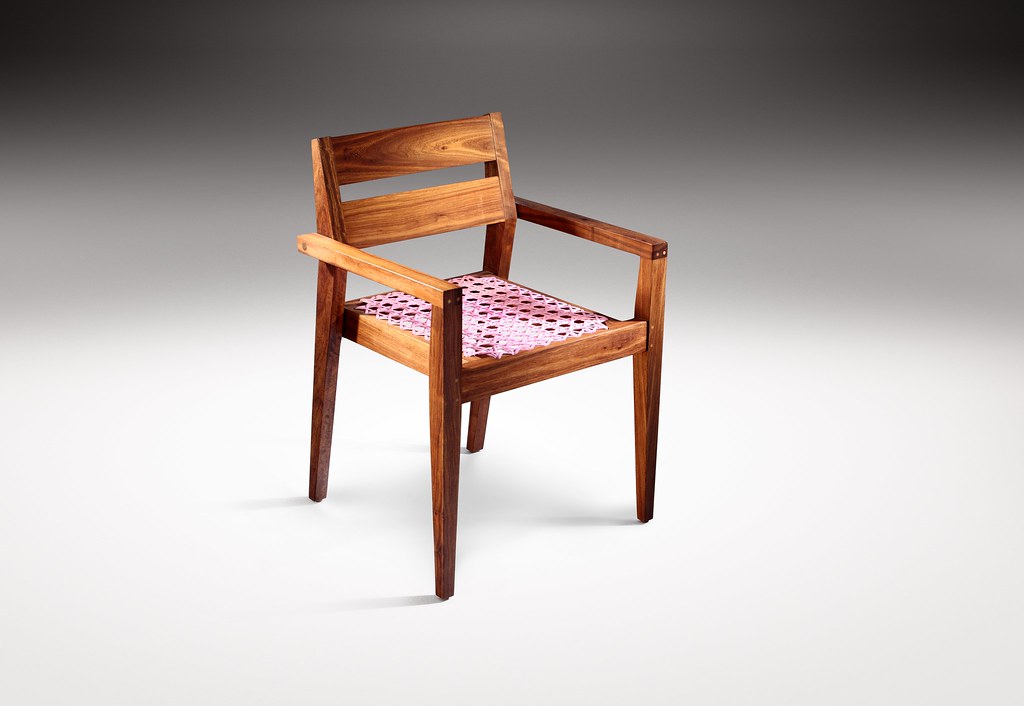
Hettie Vance's workshop is one room on the second floor of a brick building on Church Street in Burlington, Vermont, above a shop that sells maple syrup to tourists. She has worked there since 1981. The room has two chairs, a worktable, a soaking tub, several coils of binding cane in a basket on the floor, and a window that looks out across Lake Champlain to the Adirondacks.
On the morning of April 9th, 2026, the chair on the bench was an American side chair, walnut, made by a regional manufacturer in Grand Rapids, Michigan, around 1925, with a hand-caned seat that had given way under a hundred years of sitting. The owner had brought it in two weeks earlier from a town near Stowe.
Hettie was on day three of the job. The first day had been spent stripping the old cane, scraping the chair rails clean, examining the holes in the rails for damage or enlargement, and soaking new strands of binding cane in the tub by the window.
Hand caning of the kind Hettie does is one of the oldest woven seat techniques in continuous practice in North America. It is sometimes called seven-step caning, after the seven distinct passes of cane that produce the finished pattern. Each pass goes through the holes in a different direction, and together they produce the familiar octagonal mesh.
The first pass runs front to back, parallel strands threaded through the holes in the front and back rails. The second pass runs left to right, parallel strands threaded through the side rails. The third pass is a second front-to-back, doubling the first.
The fourth pass is the first diagonal, threading from front-left to back-right, weaving over and under the strands already in place. The fifth pass is the second diagonal, front-right to back-left. The sixth pass is the binder, a thicker strand of cane laid around the perimeter and pegged through the rail holes to anchor everything. The seventh is the corner pegs.
Done properly, the result is a seat that will hold an adult of average weight for fifty to eighty years before it needs to be done again. Hettie has re-caned chairs that her predecessor in the workshop, a Norwegian-born caner named Olaf Ekstrand, caned in 1962.
On the morning I watched, Hettie was on the second diagonal. She had finished the first three passes the previous afternoon. The cane she was using was Indonesian binding cane, grade 2.5, which she buys from a supplier in upstate New York that has imported from the same plantation in Sulawesi for forty years.
Each strand of cane, before being woven, is soaked in warm water for twenty minutes. Soaking makes the cane pliable. Cane woven dry will crack at the bends. Cane that has been soaked too long, or that has been allowed to dry out and then re-soaked, will lose strength and discolor. Hettie soaks in small batches and works each batch within the hour.
The diagonal passes are where the geometry of the seat reveals itself. The strands have to weave over and under the previously laid strands in a strict alternating pattern, which means the caner has to look not at the strand in her hand but at the structure of what she has already done.
Hettie's hands moved with a quietness that was not haste. She worked from a sitting position at the bench, the chair upside-down in a leather-padded cradle she had made herself in 1984. A pegged awl in her right hand pulled each strand through the hole below; her left hand fed the strand and held the tension.
The tension is, in her words, the whole game. Too tight, and the seat will pull the rails inward and split them along the grain within a year. Too loose, and the seat will sag within five. The correct tension is judged by feel and by the slight resonance the cane makes when plucked.
She plucked one finished pass with the back of a fingernail. It made a quiet sound, like a low harp string. That, she said, is what you want.
Hettie charges by the hole. A standard American side chair has about seventy-six holes in its rails. At her current rate, that is approximately three hundred and fifty dollars in labor, plus materials, plus a small overhead for the workshop. A new mass-produced chair of comparable quality, machine-caned, costs less than two hundred dollars. The reason her workshop has been in continuous business for forty-five years is that her customers are not comparing her work to a new chair.
They are comparing it to losing the chair their grandmother sat in.
Most of her work, she said, comes from one of three sources. Estates. Auctioneers who need a piece prepared for sale and know that a properly re-caned seat adds more value than it costs. And families with a chair that has been in the family for a hundred years and is not allowed to be thrown away.
The Stowe chair was the third kind. The owner had inherited it from her grandmother, who had it from her own mother, who had bought it new in Burlington in 1925, possibly from a shop on the same street that Hettie's workshop now occupies.
The binder pass went on at four in the afternoon. Hettie threaded a heavier strand around the perimeter of the seat, anchoring it at each corner with a hardwood peg driven into a corresponding hole in the rail. The corner pegs were trimmed flush with a chisel. The bottom of the seat was tidied. The whole job had taken just over twelve hours of bench time spread across three days.
She turned the chair right-side up and set it on the floor. The seat held her weight without a sound. The light through the window was the late-afternoon light of a Vermont April, long and yellow on the brick wall opposite. The chair looked, she said, like a chair again.
It would be picked up the following Tuesday. The owner had not seen it since she brought it in, and Hettie, who has done this work for forty-five years, said that the moment of pickup is still the part of the job she does not get tired of.
Filed under