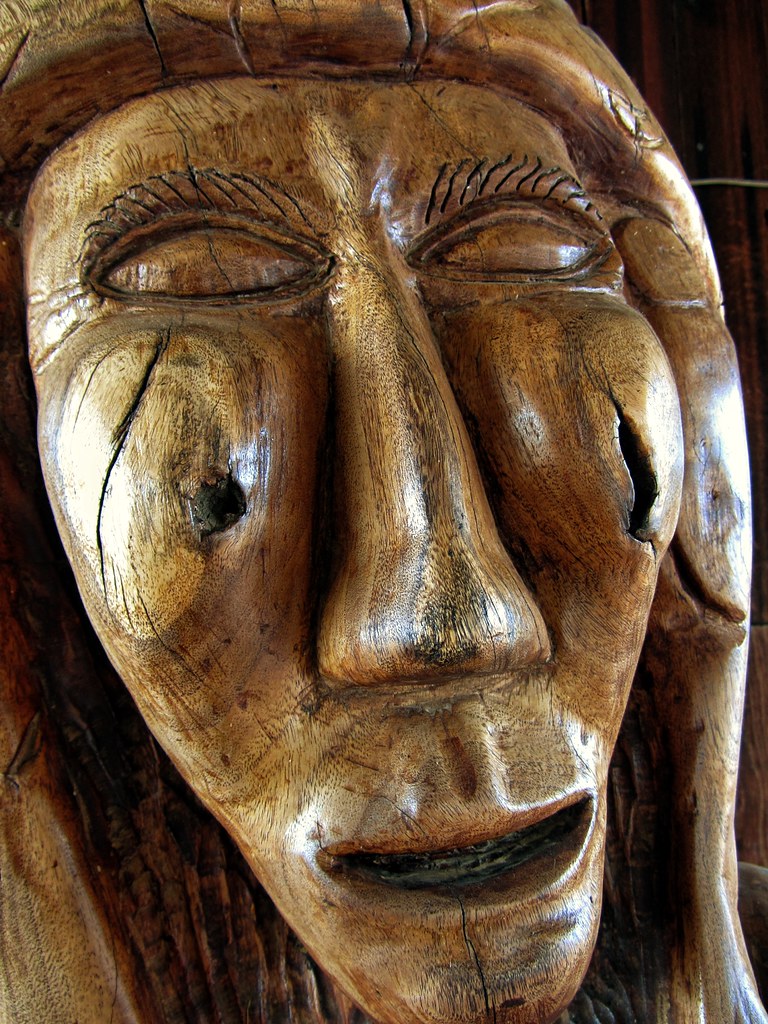
The figure stands one hundred and seventy-two centimetres tall, holds a bundle of carved wooden cigars in its left hand, and bears, faintly visible on the underside of its plinth, the chiselled initials S.A.R.
Those initials are most likely Samuel A. Robb, the New York carver who operated a workshop on Canal Street from approximately 1876 until his death in 1928. The figure is earlier than his independent practice, however, and is thought to have been made around 1872 during his apprenticeship under Thomas V. Brooks.
The piece came into the studio on a Thursday in February, lifted from the back of a transport van by two movers who had been instructed not to touch the polychrome surface with their gloved hands.
It had been bought at a Cooperstown estate auction in November 2025 for thirty-eight thousand four hundred dollars by a collector from Saratoga Springs named Halvor Brand, who already owned three trade figures and wanted this one to be the last he acquired.
Brand's instruction was simple. The figure was not to be restored. He wanted it conserved in the condition in which it had been found.
Conservation, in the museum sense that Brand intended, means the stabilisation of an object's existing material without the addition of new material that imitates the old. Repainting a faded polychrome figure is restoration. Stopping the existing paint from flaking off further is conservation.
The figure's paint, examined under a binocular microscope at ten times magnification, showed three discrete layers. The lowest was the original 1870s polychrome, applied in oil over a thin gesso ground.
Above it was a partial repaint, probably from the 1910s, that touched up the face and the bundle of cigars but left the body largely untouched. Above that was a thin discoloured varnish, probably an early-twentieth-century shellac, that had darkened to a warm amber.
The 1870s layer survived across about seventy percent of the figure's surface. The 1910s repaint covered perhaps twenty percent. The remaining ten percent was bare wood where all paint had been lost.
Conservation in this situation has a settled methodology. The original paint is consolidated. The repaint is documented and left in place. The bare wood is left bare or, occasionally, in-painted in a reversible medium with a clearly different visual register so that no viewer or future conservator can mistake the new for the old.
Consolidation was the first job. The flaking original polychrome was injected from beneath with a dilute solution of Paraloid B-72, a thermoplastic acrylic resin used in conservation since the 1960s and known to remain reversible for at least sixty years.
Injection was done with a hypodermic needle of the smallest available gauge, working in passes of perhaps a square centimetre at a time. The work took eleven sessions of three to four hours, spread across six weeks.
The darkened shellac varnish was the most contested decision. The conservator initially recommended leaving it in place on the grounds that its discoloration was now part of the object's history. Brand asked that it be thinned but not removed.
Thinning was done with ethanol on a cotton swab, working in extremely small areas, frequently moving the swab to a clean section, and stopping the moment the underlying paint began to show colour transfer.
The result was a varnish reduced by perhaps thirty percent of its original thickness. The figure's overall appearance lightened slightly. The original polychrome's reds and blues, which had been almost invisible under the amber haze, became readable as colours again.
The bare-wood areas were not in-painted. Brand had been clear that he wanted the losses to remain visible. The conservation reports a future restorer will read should make it possible to fill these areas at a later date if a different owner wishes.
Structural stabilisation was minor. The figure's right wrist had a hairline crack that was injected with hide glue and clamped overnight. The plinth had three small surface losses that were filled with a reversible wax fill toned to the surrounding colour.
The piece was delivered to Brand's home in Saratoga Springs on April 9, 2026, on a custom-built oak base designed to support the plinth without contact with the polychrome. The base is bolted to the floor on a small platform that will allow the figure to be removed without disturbing the surrounding architecture.
Brand sent a photograph the following week showing the figure standing in a north-facing room beside a window that has been fitted with UV-filtering film. The room's temperature and humidity are monitored by a small data logger that records to a memory card.
The figure has now been in place for two months. The conservation report, the photograph archive, and the documentation of materials used will be deposited with the American Folk Art Museum in New York under a deed of gift effective on Brand's death, which is the kind of arrangement that conservation, as a discipline, makes possible. A restored figure can be enjoyed. A conserved one can be studied.