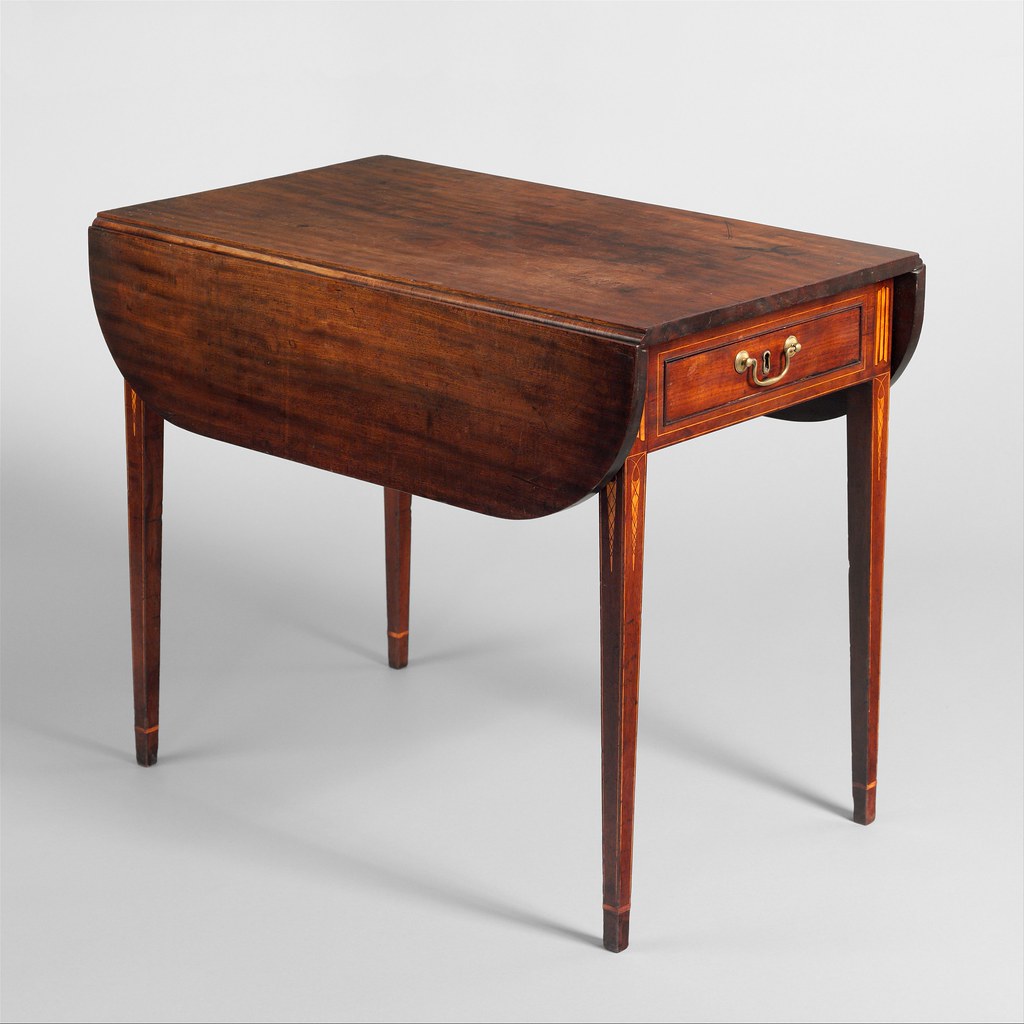
The table arrived on the morning of March 9, 2026, carried into the workshop by its owner, a retired schoolteacher named Constance Roper, who had bought it at auction in Litchfield in 2019.
It is a Pembroke table, the small-leaved drop-leaf form named for Henry Herbert, ninth Earl of Pembroke, who is sometimes credited with commissioning the original design in the 1750s. The table dates from approximately 1785 and is made of Cuban mahogany of the dense, dark-grained type imported into England in considerable quantity in the late eighteenth century.
The principal damage was a split in the western leaf, running approximately fourteen centimetres along the grain from the leaf edge inward. The split was the result of a single hard knock, probably in the last decade, against a heavy object.
The split's edges were clean and had not been previously repaired. This was a small piece of good news. A previously glued joint, opened and reglued, never holds as well as a fresh repair.
The leaf was removed from the table by lifting it slightly and sliding the rule-joint hinges out of their seats. The hinges were brass butt hinges of the standard period type, with hand-cut steel screws.
The split was opened with a thin palette knife to allow inspection of the interior. No previous glue residue was found. The grain was straight and the wood inside the split was clean.
Hide glue was prepared in the workshop's small glue pot at the standard concentration. The split was glued with a thin syringe, clamped with three sash clamps padded with softwood cauls, and left for twenty-four hours.
Squeeze-out was cleaned with a damp cloth approximately one hour into the clamping, when the glue had begun to gel but had not yet cured. This is the optimal moment for removing excess hide glue. Earlier removal smears, later removal scrapes.
The repaired leaf was inspected the following morning. The joint was tight and the surface flat. A light pass with a card scraper, working only the immediate joint area and only with the grain, brought the surface flush.
The finish was the more contested part of the project. The table had been waxed periodically for perhaps two hundred years, and the accumulated wax layers had become a kind of mottled brown veneer over the original french polish.
Stripping the wax and the underlying polish to bare wood would have been straightforward but would have removed the patina entirely. A patina of this depth, on a piece of this age, is part of the object's value.
The decision was to clean the surface, repair localised finish losses, and re-polish only where the existing surface had failed.
Cleaning was done with a cotton pad dampened with white spirit and a small amount of pure beeswax, worked in circular motions of perhaps thirty seconds per square hand-width, then wiped clean with a dry cloth.
The wax film yielded slowly. Approximately six hours of cleaning, spread across two days, brought the surface down to a thin even layer of old shellac with the original patina largely intact.
Localised finish losses, of which there were perhaps a dozen across the top, sides, and leaves, were filled with fresh shellac applied by a small rubber pad. The new shellac was tinted with alcohol-soluble dye to match the surrounding colour as closely as possible.
Matching old shellac is a matter of patience. The tinted shellac was applied in successive thin coats, with each coat allowed to dry for several hours, and the colour assessed under both natural and artificial light before the next coat was applied.
The hinges were the simplest part of the work. The brass butt hinges were removed, cleaned in a paste of jeweller's rouge and lemon juice, dried, and waxed. The original steel screws, two of which had snapped at some point in the table's history and been replaced with brass screws of a slightly larger gauge, were left as found.
The repaired leaf was reinstalled by sliding the hinges back into their seats and tightening the screws. The leaf now drops smoothly and lies flat against the supporting bracket.
The table was delivered to Constance Roper on May 22, 2026, installed in her dining room in Sharon, Connecticut, on a Persian rug that has been in the family since the 1920s. The leaves now bear weight again. A vase of irises sat on the western leaf in the photograph she sent two weeks later.
The split, on close inspection, is visible as a thin dark line in the right light. Roper described it as a record of a moment she did not witness but is now responsible for, which is one way of thinking about the things we inherit and the things we accept the responsibility of keeping.