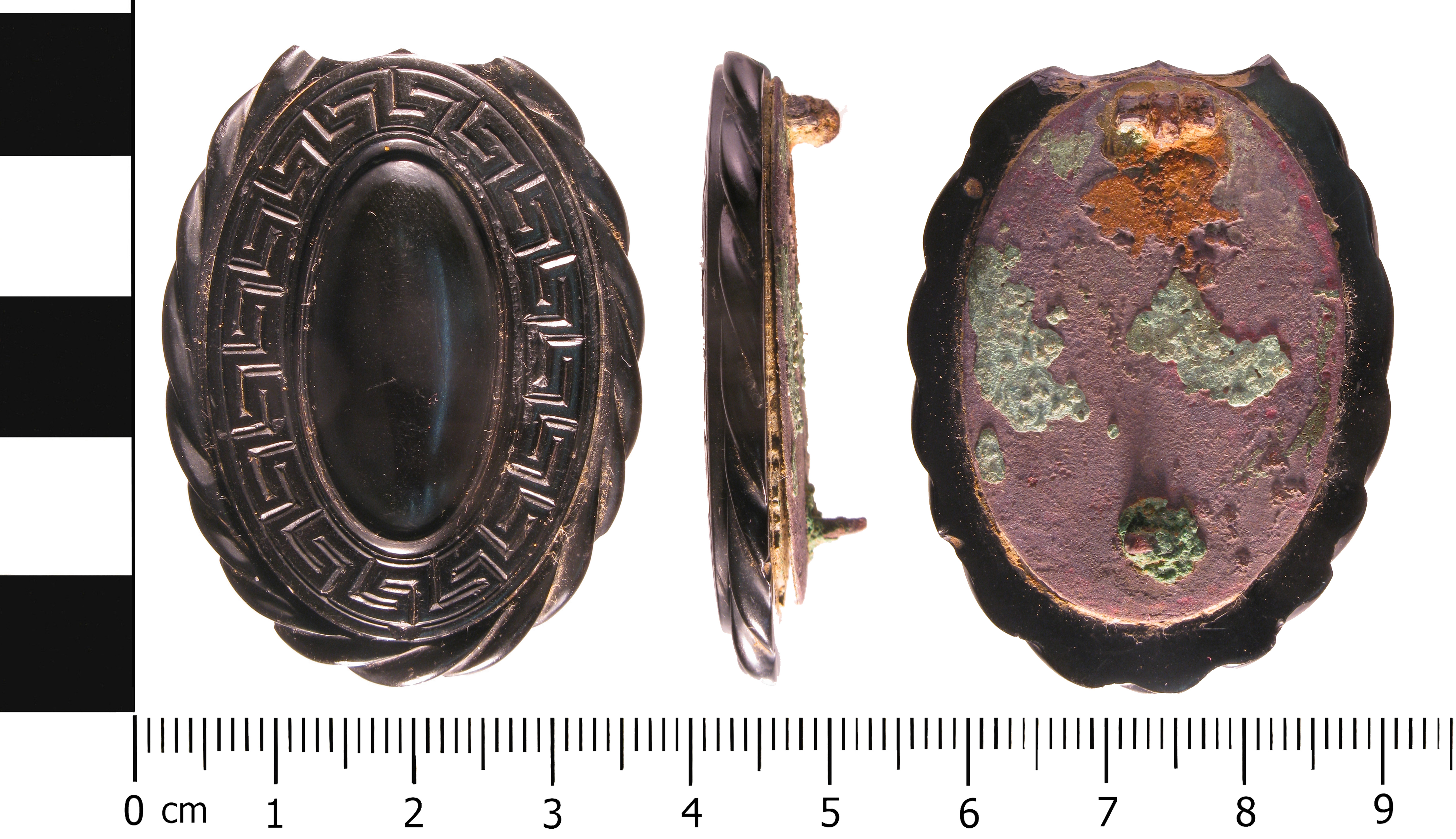
The brooch came into the workshop in a small wooden box lined with faded purple silk, accompanied by a piece of paper on which someone had written, in pencil, Aunt Harriet, 1873.
It had been sent from Stockport by a woman named Joanna Pell, who had inherited it from her grandmother, who had inherited it in turn. The line of descent was undocumented past 1900 but plausibly continuous.
The brooch is a Whitby jet oval, approximately 42 millimetres long and 28 millimetres wide, with a glazed compartment at its centre containing a plait of brown hair. The hair is human and almost certainly contemporary with the piece.
The bezel that held the glazing had cracked along its lower edge, and the C-clasp pin on the reverse was missing entirely. The hinge for the pin remained but had been bent slightly, suggesting the pin had been broken off rather than lost.
Whitby jet, the fossilised wood of the monkey-puzzle tree, was the dominant material of English mourning jewellery from roughly 1860 until the early 1890s. Queen Victoria's adoption of jet for her own mourning after the death of Prince Albert in 1861 created the market that sustained the Whitby industry for three decades.
By 1900 the trade had largely collapsed. The last commercial jet-worker in Whitby retired in 1958. Repairs to jet pieces today are typically undertaken by lapidaries who have learned to work the material on adjacent jobs.
The repair to the bezel was made by a goldsmith in Manchester named David Ahearn, who has been working in the trade since 1991. The bezel was originally a single piece of pinchbeck, an alloy of copper and zinc developed in the 1730s as a gold substitute.
Pinchbeck is not manufactured commercially in 2026. A small workshop in Hatton Garden produces an approximation for restorers, in batches of perhaps a kilogram at a time, sold through a single dealer in Birmingham.
Ahearn obtained two hundred grams of the alloy in November of 2025. The cracked bezel was cut away with a piercing saw, the new bezel rolled, sized, and soldered onto the back plate, and the join polished with a series of three abrasive grades down to four-thousand grit.
The replacement pin was made from a length of phosphor-bronze wire of the original gauge, 1.2 millimetres, drawn through a Birmingham wire-drawing plate that Ahearn keeps for exactly this kind of work.
The pin was tempered by heating to a straw colour and quenching in oil, then sharpened on an oilstone. The hinge was straightened with a pair of brass-jaw pliers and the new pin fitted.
The hair-work was the most delicate part of the project. The plait inside the central compartment had loosened over a century and a half, and one of the three braided strands had broken near the upper end.
Repairs to Victorian hair-work are made by a small number of practitioners worldwide. The piece was sent to a hair-worker named Margery Tate, who operates from a converted scullery in a Norfolk village and is, by her own count, one of perhaps six people in the United Kingdom doing this work commercially.
Tate received the brooch on December 8 and returned it on January 19, having re-secured the plait with a tiny stitch of human hair from her own working supply, which she keeps in labelled paper envelopes by donor and decade.
The hair she used was donated by a woman in Lincoln who had her grey-brown hair cut short in 1982 and gave the cuttings to a friend who eventually passed them to Tate. The match to the original plait is close enough that the addition is invisible at any normal viewing distance.
The glazing was the simplest part of the work. Original Victorian glazings were typically rock crystal, cut and polished to fit the bezel. The brooch's glazing was intact and only required cleaning, which was done with a cotton swab dipped in distilled water.
The reassembled brooch was returned to Joanna Pell on February 4, 2026, along with a written record of the work, a small envelope containing the cut-away pinchbeck and the broken pin stub, and a brief note from Ahearn explaining the materials used.
Pell wrote in late February to say that the brooch had been worn to a family gathering in Macclesfield and that her mother, aged eighty-nine, had recognised it from a single photograph of her own grandmother in which it appears at the throat of a high-collared dress.
The photograph is now being scanned and added to the brooch's file, which will travel with the piece when it next changes hands. Restorations of this length produce, eventually, a kind of dossier. The dossier is what makes the difference, fifty years on, between an old piece of jewellery and a documented family object.