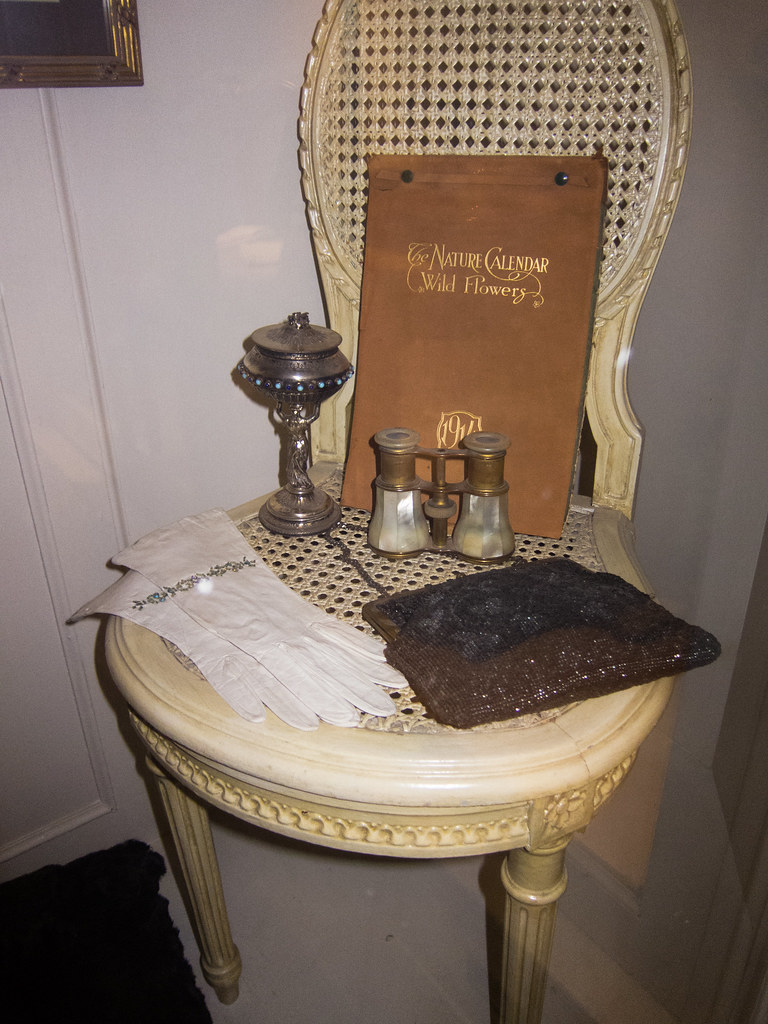
The opera glasses came into the workshop on the morning of April 14, 2026, in a small leather case lined with faded green velvet, accompanied by a hand-written card that read, in French, Pour Lucienne, de son père, Noël 1881.
They are a pair of Lemaire fils opera glasses, the Galilean-design instrument made in considerable numbers at the Lemaire workshop in Paris between approximately 1850 and 1920. The barrels are rosewood, the trim is gilt brass, and the eyepieces are inset with carved mother-of-pearl.
Lemaire was the most prolific manufacturer of opera glasses in nineteenth-century Europe. The firm's products were sold under their own name and also through retailers such as Cartier and the Maison Aucoc in Paris and Garrard in London.
These glasses were sold through an unnamed retailer in Lyon, according to the brass plate on the lower eyepiece, which is engraved with the words Maison Roussel, Lyon in a small italic hand.
Initial condition: the central focusing mechanism had seized; the right barrel's mother-of-pearl inlay had three losses, each approximately three millimetres across; the optics were correct but slightly misaligned, causing a double image at full extension; and the velvet case had developed mould along its upper seam.
The owner, a woman named Sophie Bachmann, had inherited the glasses from her grandmother in 2019 and had carried them in her handbag to several concerts before discovering the alignment problem at a performance at the Wiener Konzerthaus in February.
The focusing mechanism was the first job. It was unseized by application of a single drop of penetrating oil to the central wheel, allowed to work for forty-eight hours, and then gently exercised by hand until the mechanism turned freely.
Galilean opera glasses use a simple central wheel that moves both barrels in and out together. The mechanism is robust but requires occasional lubrication, which these glasses had not received in perhaps half a century.
After the mechanism was freed, the original lubricant, which had become a brown gum, was flushed with naphtha and a small acid brush. New lubricant, in the form of a thin synthetic clock oil, was applied with the tip of a needle to the bearing surfaces only.
The mother-of-pearl losses were the most visible damage. The original inlay was cut from sheets of nacre approximately one millimetre thick, polished on the show face and adhered to the rosewood with a thin layer of shellac.
Replacement mother-of-pearl is still produced commercially, though most modern nacre comes from farmed sources and is brighter and more uniform than the wild Pacific nacre used in the nineteenth century.
A small piece of antique mother-of-pearl, salvaged from a broken button card bought at a flea market in Marseille in 2024, was used for the repair. The colour and figure match the surviving inlay closely enough to be invisible at any normal viewing distance.
The replacement pieces were cut to shape with a small jeweller's saw, sanded to match the surrounding contour, polished on a series of three abrasive grades, and adhered with fresh shellac. The repair took most of an afternoon.
The misaligned optics required the most patience. Collimation of a Galilean instrument is done by adjusting the seating of the objective lens within its cell, with the eyepiece used as a reference.
Each barrel was opened by unscrewing the retaining ring at the objective end, the lens lifted out on a small suction cup, the seating cleaned with a cotton swab dipped in distilled water, and the lens reseated with the help of a small alignment jig.
The jig is a small wooden block with a fixed eyepiece and a target at the far end of the bench. The lens position was adjusted by hand, in increments of perhaps a quarter of a degree, until the target image was sharp and the two barrels showed the same image at the same point.
The work took four hours and was checked the following morning under different lighting conditions to confirm that the alignment held.
The velvet case was the simplest part of the project. The mould was removed with a soft brush and a vacuum on the lowest setting, the lining was cleaned with a cotton pad dampened with a solution of one teaspoon of vodka in a cup of distilled water, and the case was allowed to air for forty-eight hours.
The card from 1881 was removed during the cleaning, placed in an acid-free envelope, and returned to the case with the glasses on completion.
Bachmann collected the glasses on June 8, 2026, and used them the following evening at a performance of Mozart's Idomeneo at the Theater an der Wien. She wrote the next day to report that the optics were sharp, the focusing mechanism turned smoothly, and that the card from her great-grandfather had been read aloud at home before the performance, in the same language and very nearly the same room in which it had first been written.