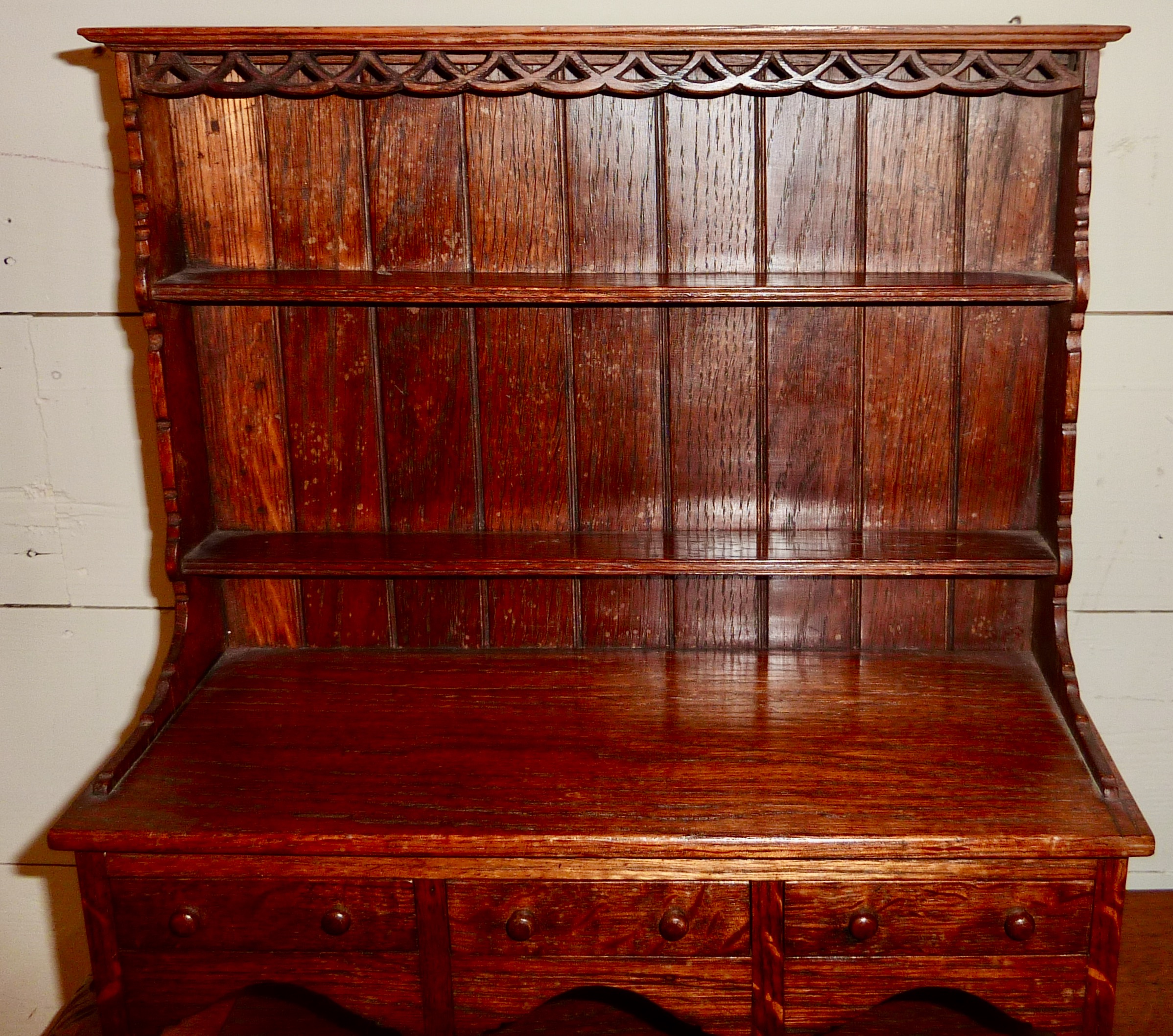
The chest stands in a low-ceilinged sitting room in Llandeilo, against the inner wall of what was once a drovers' inn. It is a Welsh oak chest of drawers, four drawers wide and four drawers deep, with a moulded plinth and brass bail handles. The handles are not original; the original wooden knobs were replaced with brass in roughly 1890 and the holes for the new fixings are slightly off-centre on three of the drawers.
The current owner is a retired schoolmistress named Bethan Morgan, who inherited the chest in 2011 from her aunt. Mrs. Morgan asked The Pewter, through a Cardiff dealer who had appraised it for insurance, whether anything more could be known about its history.
The chest is dated. Inside the back of the bottom drawer, faintly cut into the oak with a chisel, is the date 1842. Beside the date, in graphite, is a name that has been re-traced at least three times over the years by successive owners. The name reads Dafydd Pugh, joiner, Llanwrda.
Llanwrda is a village six miles north of Llandeilo on the Carmarthenshire-Powys border. The 1841 census, taken on the night of June 6 of that year, lists Dafydd Pugh as a joiner aged 34, living with his wife Mary and three children in a stone cottage on Cwm Road. The 1851 census lists him at the same address, now with five children, occupation given as joiner & carpenter. He died in 1873 and is buried in the churchyard of Llanwrda parish.
Pugh's workbook, held at the National Library of Wales in Aberystwyth, records a commission in March 1842 from a farmer named John Davies of Cwmifor Farm for a chest of drawers of best oak, four wide four deep, plinth moulded, knobs of cherrywood, 28 shillings. The commission is dated March 14. The chest in Mrs. Morgan's sitting room is, as far as can be confirmed by the dimensions in Pugh's notebook and the date carved inside the bottom drawer, that chest.
Cwmifor Farm is three miles from Llandeilo and is still farmed today, by a Davies who is, as far as anyone in the parish can establish, the great-great-grandson of the John Davies who ordered the chest. The current Davies has the original chest's twin: a slightly smaller chest, ordered by his great-great-grandmother in 1849, also by Pugh, also of oak, with the same plinth profile and the same chisel-cut date.
Provenance research often runs through wills. John Davies of Cwmifor died in 1881 and the chest passed to his eldest daughter, Annie Davies Lloyd, who had married a Llandovery innkeeper. Annie moved the chest to Llandovery in 1881 and used it in a guest bedroom of the inn for forty years.
Annie's daughter Megan inherited the chest in 1923. By then the cherrywood knobs had been replaced with brass, probably during a refurbishment of the inn in 1890; Megan's mother, in a letter to her own sister, wrote that the inn is to have brass throughout and the old wooden knobs are to be done away with. The letter survives because Annie kept her sister's replies, and the bundle was donated to the Carmarthenshire Archives in 1989.
Megan married a Llanelli draper in 1924. The chest moved to Llanelli and stayed there until Megan's death in 1971. It then went to her sister-in-law, Mrs. Morgan's aunt, who lived in a small terrace in Ammanford. The aunt kept the chest in a hall and used it for table linen. Mrs. Morgan inherited it in 2011 and moved it to Llandeilo.
Four named owners, six addresses, 184 years, and a chain of female inheritance through three generations.
The graphite inscription inside the back panel is what closes the chain. It is not Pugh's hand; Pugh's chisel work on the date is plain. The graphite name appears to have been added by a later owner, perhaps Annie Lloyd in the 1880s, who would have been a child when the chest was made and who would have known Pugh's name from her father. The graphite has been re-traced at least three times, most recently by Megan in roughly 1950, when she wrote in her own hand traced over to keep clear, M.L. May 1950.
The re-tracing is unusual. It suggests a household practice of maintaining the inscription as a record. Welsh country furniture of this period rarely carries a maker's name, and when it does the name is usually scratched in once and forgotten. To have the name re-traced across three generations is, in the experience of the Welsh oak specialist who consulted on this piece, almost unique.
The specialist, a retired curator from the St Fagans National Museum of History named Owain Pritchard, drove to Llandeilo in April 2026 to examine the chest in person. He spent three hours with it. He measured the plinth, photographed the dovetails (which are hand-cut and irregular in the manner consistent with Pugh's other documented work), and lifted the bottom drawer to read the inscription.
Pritchard's report runs to fourteen pages. He concludes that the chest is, with documentary certainty, the chest commissioned by John Davies in March 1842 from Dafydd Pugh of Llanwrda. He notes that the brass handles, while not original, were added within the chest's first fifty years and are themselves of historical interest. He recommends that the handles not be replaced.
Mrs. Morgan does not plan to sell. She has asked Pritchard whether the chest should be willed to a museum. Pritchard has advised her against it. He says that the chest is most valuable, in the historical sense, in the family that has kept it, and that a museum would record it once and then store it in climate-controlled darkness for fifty years.
Mrs. Morgan has decided to leave the chest to her niece, who lives in Carmarthen. The niece is twenty-nine and works for the Welsh ambulance service. She has not yet seen the chest in its new role as a documented object, but she has agreed to take it.
The chest, Pritchard wrote in the last paragraph of his report, is still working. The drawers still slide. The plinth is still tight. The graphite inscription is still legible. The cherry knobs are gone but the brass replacements have themselves aged into honesty. It is, Pritchard wrote, a piece of furniture that has been continuously useful for 184 years, and the most important thing one can do for it now is to continue using it.