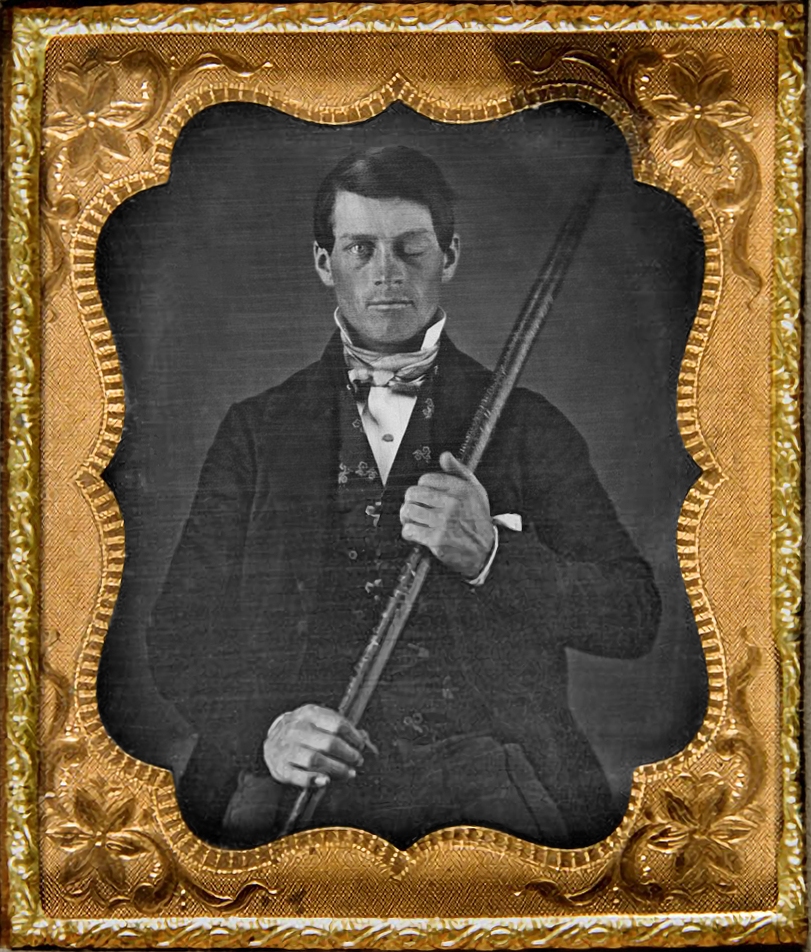
The daguerreotype is sixth-plate, two and three-quarter inches by three and a quarter, in a leatherette case with a velvet lining. The image shows a young man in a Union infantry uniform, photographed from the waist up, holding a Hardee hat in his left hand and a small Bible in his right. The exposure is sharp; the lens was a good Petzval, well stopped, with the focus on the face.
The man is unsmiling, as was the convention. His eyes are slightly hooded and his mouth is set. He looks about nineteen.
The case came to a Bermondsey dealer named Harriet Pickford in March 2026 in a box of mixed Victorian photographica purchased at a country auction near Sevenoaks. Pickford recognised it as an American daguerreotype rather than a British ambrotype by the mat and the case style, and she set it aside for closer examination.
What identified the soldier was a small mark, no more than five millimetres across, stamped into the lower right corner of the brass mat. The mark is a maker's stamp: W. NOTMAN, NEW HAVEN. William Notman of New Haven, Connecticut, operated a daguerrean studio at 217 Chapel Street from 1859 to 1864, when he closed the business and moved to Hartford. His name appears in the New Haven city directories for those years and in the surviving census records.
Notman's studio book, miraculously, survives. It is held in the manuscripts collection of the New Haven Museum and was digitised in 2018. The book records every sitter Notman photographed between July 1859 and his closure in October 1864. Each entry gives the sitter's name, the date, the format ordered, and the price.
Pickford emailed The Pewter in late March and forwarded a high-resolution scan of the daguerreotype. Beatrix Joost in Amsterdam took the case file and began work with the studio book.
The uniform dates the sitting. The soldier wears the four-button sack coat and dark blue trousers that the Union army adopted for federal infantry from 1861 onward. His cap badge — visible faintly on the Hardee hat in his hand — is a brass bugle, the infantry insignia. The hat itself is the 1858 Hardee, regulation for federal infantry until late 1862 when it was largely abandoned in favour of the kepi.
The combination dates the photograph to the summer or early autumn of 1862. The sitter would have been a volunteer in his first months of service.
Notman's studio book for August 1862 lists, on August 12, a sitting for Cpl. E. T. Bidwell, 14th Conn. Vols., one sixth-plate & one quarter-plate, $3.50, paid. The 14th Connecticut Volunteer Infantry was mustered into federal service at Hartford on August 23, 1862, and travelled south on August 25. The regiment fought its first major action at Antietam on September 17, less than a month after Bidwell's sitting.
Edwin Thomas Bidwell of Middletown, Connecticut, born November 8, 1842, enlisted in Company K of the 14th Connecticut on July 30, 1862. He was nineteen. The regimental roster lists him as a corporal, age nineteen, occupation given as clerk. He was killed at the Battle of Antietam at the Sunken Road on September 17, 1862. His body was identified by a fellow soldier from Middletown and returned to Connecticut for burial in Indian Hill Cemetery.
The daguerreotype Bidwell sat for on August 12 was sent home before he marched south. His mother, Mary Bidwell, kept it on a mantelpiece in the family parlour for the rest of her life. She died in 1907. The image then descended through Bidwell's younger sister Caroline, who married a Hartford banker, and from Caroline to her daughter Eleanor, who married an English businessman and moved to Kent in 1923.
Eleanor Bidwell Howard died in 1971. Her effects were sold in a country auction near Sevenoaks in 1972. The daguerreotype was bought as part of a box lot by a local clergyman who kept it on a bookcase. The clergyman died in 2025 and his estate was sold in March 2026, where Pickford found it.
Five owners, four moves across an ocean, and 164 years from a New Haven studio to a Bermondsey stall.
Pickford does not plan to sell the daguerreotype quickly. She has lent it for examination to the Connecticut State Library, which holds the regimental records of the 14th Connecticut, and to the Middletown Historical Society, which is preparing a small exhibition on local volunteers for the 165th anniversary of Antietam in September 2027.
The Middletown Historical Society has located three living descendants of Edwin Bidwell's sister Caroline. The descendants have been notified that the daguerreotype exists and have been offered the option to purchase it from Pickford at her cost. They are considering it.
The case itself is in poor condition. The leatherette is split along the spine and the velvet lining is loose. A conservator in London has examined it and recommended minimal intervention; the case should be stabilised with archival adhesive and stored in a small acid-free box, but it should not be rebound. The daguerreotype itself is in good condition. The seal between the plate and the cover glass is intact and there is no visible oxidation around the edges of the image.
The image is, in the conservator's note, a clean and unrestored example of Notman's commercial work, with the further significance of an identifiable and short-lived sitter.
Bidwell sat for the photograph because his mother asked him to. He was killed thirty-six days later, in a sunken farm road in western Maryland, by a Confederate musket ball. The image she kept on her mantelpiece was the last likeness she had of him. The fact that the case survived, and that the brass mat carried a stamped maker's name, and that the maker's studio book happened to be preserved and digitised, is what allowed the man in the case to have a name again.