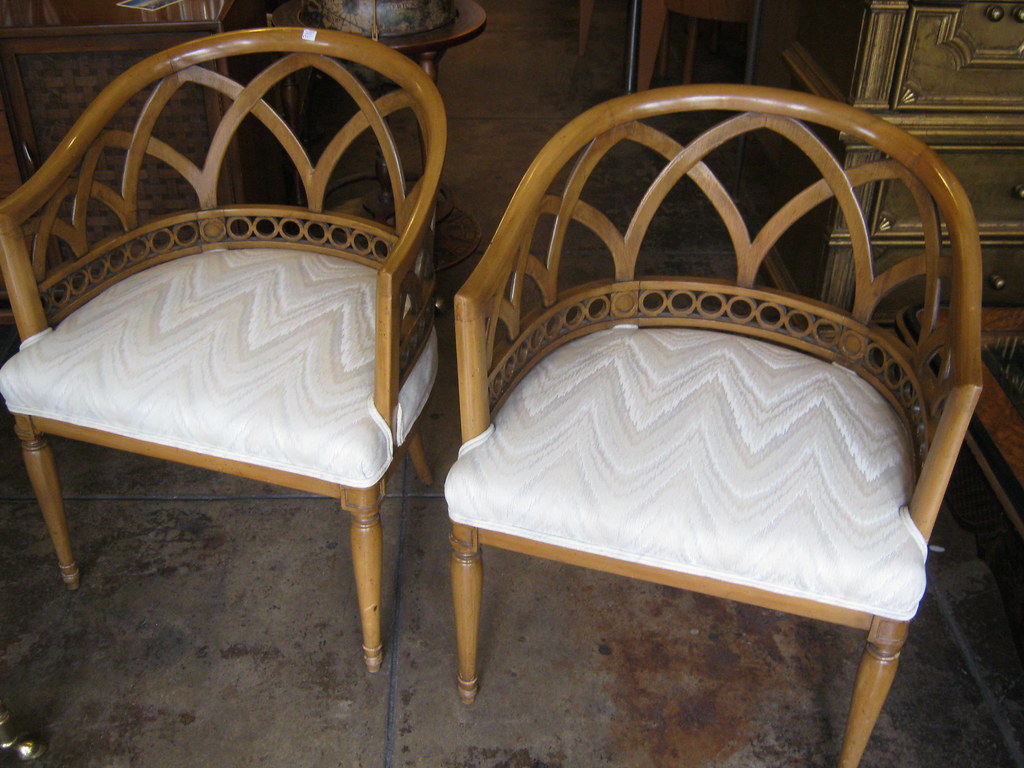
The chair has been called Sanderson, Seymour, and once, in a 1987 dealer's invoice, a generic school of Salem. The receipt that settled it was found on a Tuesday in March 2026 by a junior cataloguer at Skinner who was making an inventory of a Newport estate lot.
The chair is a Federal-period side chair with a shield back, reeded legs tapering to a small spade foot, and a slightly bow-fronted seat rail. The carving on the back splat is a vase of stylised tulips and acanthus, sharply cut, with a confident undercut that is the kind of work a senior cabinetmaker did himself rather than handed to an apprentice. It is one of a pair. Both chairs came out of the estate of a Newport widow named Constance Vail Hadley, who had died at ninety-four in November 2025.
The receipt was in the back of a drawer in a small Sheraton-period side table that had been sold with the chairs as part of the same lot. The cataloguer, whose name is Petra Welkin, was lifting the drawer to weigh it when she felt a paper at the back, jammed into the gap between the drawer back and the runner.
The paper is roughly five inches by four, folded into quarters, written in iron-gall ink that has bled slightly through the paper. The text is in a tradesman's hand. Received of Mr. Jonathan Vail of Salem, payment in full for six chairs of mahogany with shield backs & reeded legs at $7 each, $42 total, this 14th day of October 1801. Elijah Sanderson.
The signature matches the autograph specimens of Elijah Sanderson held at the Peabody Essex Museum, which Cyrus Peake examined in late March. The hand is consistent with three other Sanderson receipts in the museum's collection, dated 1798, 1803, and 1809. The price — seven dollars per chair — is consistent with Sanderson's known pricing for shield-back chairs of this date.
Six chairs were ordered. Two have now been identified. The other four are not in the Vail family records, but two side chairs of the same pattern and similar carving have been catalogued by the Winterthur Museum since 1962, attributed to Salem, c. 1800, possibly Sanderson workshop. Winterthur's two chairs and Hudson's two chairs match in every measurable particular, including the width of the reeding on the legs and the small irregularity in the third tulip on the splat where the carver's chisel slipped.
Four of the six chairs are now accounted for. The remaining two are presumed lost or dispersed.
Jonathan Vail of Salem, the buyer named on the receipt, was a merchant in the East India trade. He died in 1816 and his estate inventory, filed in Essex County, lists six dining chairs, mahogany, $36 the set. The price had depreciated by six dollars in fifteen years, which is consistent with normal wear. His daughter Sarah married a Newport shipowner named Hadley in 1819 and inherited the chairs. They moved to Newport with her.
From 1819 to 2025 the chairs stayed in the Hadley line. They were used, regularly, at family dinners until the 1950s, when Constance Vail Hadley inherited them from her mother and moved them to a smaller dining room. Two of the chairs broke during a move in 1962 and were stored in an attic. They were never repaired. The other four were sold quietly to a Newport dealer in 1971, and from there their trail goes cold; Winterthur acquired its two in 1973 from a Boston dealer who would not name his source.
The two chairs in the November 2025 estate were the two that broke. They had been repaired by a local restorer named Theodore Mancini in 1984, who replaced a section of one back leg and reglued a splat. The repairs are visible under raking light but are competent and reversible.
The receipt does three things for the chairs.
First, it confirms the maker. The attribution to Sanderson has been suspected since at least 1962, when Winterthur's curator Charles Montgomery proposed it on stylistic grounds, but no documentary evidence existed until now. Montgomery's note in the Winterthur file reads Sanderson workshop, attribution to be confirmed when documentation emerges. The receipt is that documentation.
Second, it documents the original commission. Federal-period furniture is almost always anonymous; a documented commission from a named patron to a named maker on a specific date is rare. The receipt places the chairs in a Salem household on October 14, 1801, and follows them by inheritance to Newport in 1819.
Third, and counterintuitively, it slightly lowers the auction estimate.
This is because the receipt names a price. The Mancini repairs, which were done without knowing the chairs were Sanderson, are more invasive than would have been authorised had the maker been known. A buyer who pays for a documented Sanderson chair expects original wood in the back leg. The repair, while honest, reduces the price of these two chairs against the Winterthur pair, which are unrestored.
Skinner has catalogued the chairs at $18,000 to $24,000 for the pair, with the receipt offered as a separate lot at $1,500 to $2,500. The two will likely sell to the same buyer; the receipt without the chairs is a curiosity, and the chairs without the receipt would be Salem, c. 1800, possibly Sanderson workshop, at half the price.
Petra Welkin, the cataloguer who found the receipt, has been written into the catalogue notes. This is unusual at Skinner; cataloguers are not normally named. Hudson's senior specialist asked for it.
The receipt itself will not be conserved before the sale. It will be photographed, encapsulated in mylar, and offered loose with the lot. The buyer can do as they please.
Constance Vail Hadley, who never knew her chairs were by Sanderson, kept them in a small back dining room for the last forty years of her life and ate her supper at the table they surrounded. She used the two repaired chairs herself. She told a neighbour, in 2018, that they were comfortable for short meals.