The biscuit tin is a Huntley and Palmers tin from roughly 1955, rectangular, with a slightly rusted seam at the back. It was found in an attic in Cromer in late January 2026 by a man named Adrian Stark, who was clearing his late mother's house and had reached the stage of the clearance where one opens every container.
Inside the tin, wrapped in a tea towel that had stiffened with age, were four small objects: a Victorian mourning ring, two glass earrings of no particular value, and a portrait miniature in a tarnished gilt frame, face down.
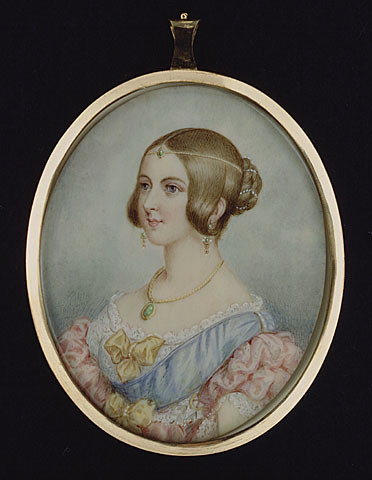
The miniature is watercolour on ivory, oval, three inches tall by two and a half wide. The sitter is a young woman in a high-waisted white muslin gown of the late 1790s, her hair dressed in soft curls around her face and held back with a narrow blue ribbon. She is shown to the waist, against a plain blue-grey background. Her expression is calm and slightly amused.
On the back of the frame, glued to the wooden backing under the velvet, is a small piece of paper. The paper is yellowed and the ink has faded. The inscription, read under raking light with a magnifier, says Mary Catherine Postle, aged 26, by S.S., Norwich, October 1798.
Stark had no idea who Mary Catherine Postle was. He brought the miniature, in its biscuit tin, to a small auction house in Norwich in February. The auction house called The Pewter.
Beatrix Joost in Amsterdam took the file and began with the maker's initials. S.S. in the context of a Norfolk miniature of October 1798 points strongly to Samuel Shelley, the London miniaturist who travelled to provincial cities on commission and is known to have worked in Norwich in the autumn of 1798. Shelley's account book, held in the manuscripts collection of the National Portrait Gallery in London, records sittings in Norwich from September 28 to October 19 of that year.
The book lists eleven sittings during that Norwich visit. The seventh sitting, on October 11, 1798, is recorded as Mrs. Postle, of Surrey Street, three guineas, paid in full.
Surrey Street in Norwich in 1798 was a residential street of merchants and minor gentry. The 1798 trade directory for the city lists, at number 14 Surrey Street, the household of John Postle, Esq., wool factor. John Postle was born in 1764 and had married, in 1796, Mary Catherine Browne of Yarmouth. She was twenty-four at the time of the marriage and twenty-six at the date of the miniature.
The miniature was almost certainly commissioned by John Postle as a gift for his wife or for himself. Shelley's price of three guineas was standard for a portrait of this size.
Mary Catherine Postle died in 1843 at the age of seventy-one. The miniature passed to her younger daughter Eliza, who married a Norwich solicitor named Henry Stark in 1827. From Eliza it descended through four generations of Starks to Adrian Stark's mother, who had inherited it in 1971 from a maiden aunt and had, apparently, put it into a biscuit tin and forgotten about it.
The Stark family has been in Norfolk for two hundred years. Adrian Stark, who runs a small electrical-contracting business in Cromer, was unaware of the connection to the Postle family until Joost's research surfaced it.
What is interesting about this miniature is not the attribution, which is straightforward, but the condition.
Miniatures on ivory are extraordinarily fragile. Ivory expands and contracts with humidity; the paint, which is watercolour mixed with gum arabic, is vulnerable to flaking; the cover glass, if it is original, is usually pitted with moisture damage by the second century of the work's life. A miniature stored unprotected in a biscuit tin in an unheated Norfolk attic for at least fifty-five years would normally be in poor condition.
This one is not. The cover glass is original and lightly tarnished at the edges but otherwise clear. The ivory has not warped. The paint is intact. The blue ribbon in the sitter's hair is as bright as it would have been in 1798.
Joost consulted a miniature conservator in The Hague named Margriet van Helst, who flew to Norwich in March to examine the piece. Van Helst's report attributes the good condition to two factors. First, the biscuit tin, by accident, provided a stable micro-environment with low light and moderately constant humidity. Second, the original sealing of the frame, with a thin strip of paper between the ivory and the velvet backing, had remained intact for 228 years.
Van Helst recommended that the miniature be re-sealed with an archival paper strip and placed in a small wooden box with silica gel for storage. The biscuit tin, she said with some amusement, could be retired.
Stark has decided to keep the miniature. He has had it framed, with a slightly larger oval mat, and has hung it in the entrance hall of his house in Cromer. He has also commissioned a small typed card to be placed below it, naming the sitter and the artist and the date.
He has, in the months since the research was completed, started to read about his own family. His grandfather was a Norwich coal merchant, his great-grandfather a solicitor's clerk; he had not previously known about Henry Stark the solicitor or the Postle wool factor. He has begun to assemble, in a single shoebox, a small family archive: the marriage certificates, the trade-directory entries, the genealogical chart that Joost prepared as part of her research.
Stark sent The Pewter a short note in April. He said that the miniature had been in his mother's attic for as long as he could remember, and that he had nearly thrown it out with the biscuit tins. He said that he was glad he had opened the tin.
The miniature is, in its new frame on the new mat, in the hallway in Cromer. Mary Catherine Postle of Surrey Street, Norwich, aged twenty-six in October 1798, looks faintly amused at the people who pass her on their way out the front door.