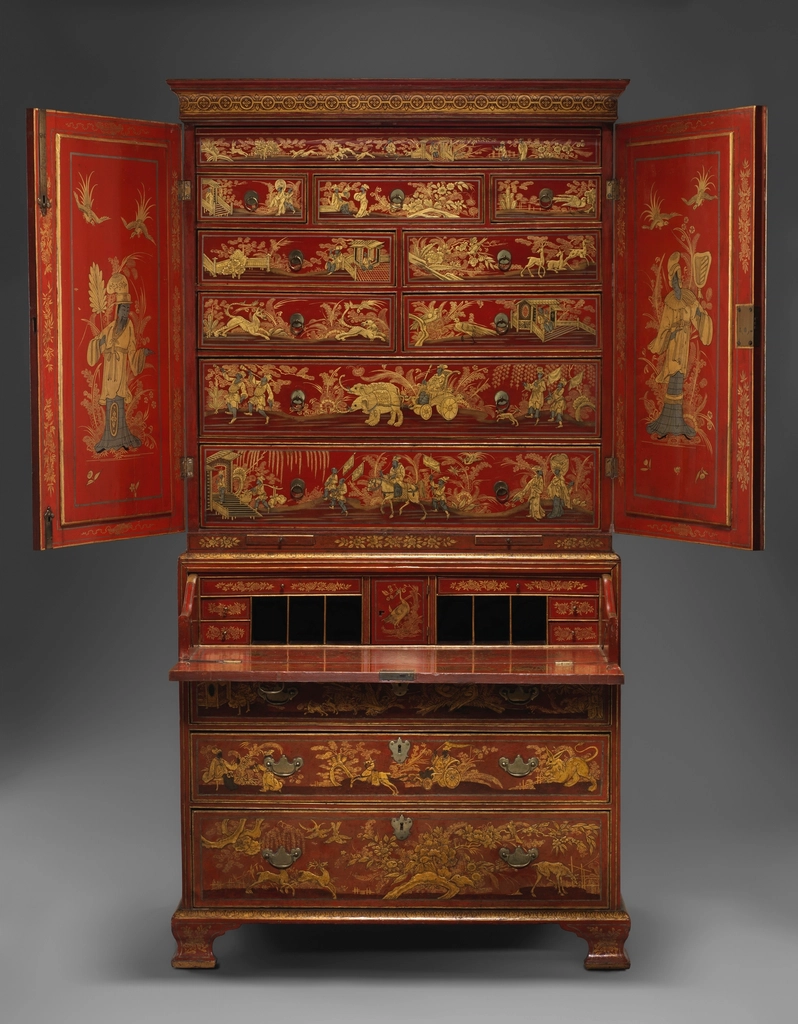
The desk arrived in the back of a borrowed Ford F-150 on the afternoon of January 11, 2025, with the slant-front lid wrapped separately in a moving blanket and the gallery of pigeonholes packed in two cardboard banker's boxes.
It had been bought four weeks earlier at an estate sale in Hudson, New York, for nine hundred and forty dollars. The vendor described it as walnut, c. 1880, working condition unknown. That phrase covered most of what was wrong with it.
The maker's label, glued inside the well of the central drawer, read A. Petersen & Sons, Cabinetmakers, Cincinnati, Ohio. There is no entry for Petersen in the standard reference, Naeve and Roberts, but a Cincinnati city directory for 1879 lists an Anders Petersen at 312 Walnut Street, occupation cabinetmaker, with two sons working alongside him.
The piece is a slant-front secretary of the type sometimes called a Wooton, though it is not a true Wooton patent desk. Wooton's improvements were patented in 1874 and lapsed in 1888. The Petersen desk borrows the swing-out compartments and the central locking arrangement but uses simpler joinery.
Initial condition, written into the workshop logbook on January 12: lid hinges sprung, two of three locks seized, leather writing surface dried to the texture of a brown-paper bag and torn in a Z across the centre, four veneer lifts along the lower carcase, one bun foot missing, the entire piece coated in a thick film that solvent tests would later identify as a mid-twentieth-century paste wax over an older shellac.
The first decision was whether to conserve or to restore. Conservation, in the museum sense, would have meant arresting decay without reversing it. Restoration meant bringing the desk back into daily use.
The client, a Manhattan literary agent named Caroline Vest, wanted to use the desk for her correspondence. The decision was for working restoration.
Disassembly took eleven days, mostly because the swing-out compartments could not be removed until the central locking bar had been freed, and the locking bar could not be freed until the brass tongue had been soaked for ninety-six hours in mineral oil.
The veneer lifts were addressed first. The original glue was hot hide glue, which is reversible. A hot-water syringe, an eyedropper, and a household iron set to the silk setting allowed each lift to be re-laid without re-veneering.
Re-veneering is sometimes necessary, but it is always a confession of failure on a piece this age. The original walnut, cut from old-growth Ohio Valley trees no longer standing, cannot be matched by anything sold in 2026.
The shellac came off with denatured alcohol on a cotton pad, working with the grain in passes of about thirty seconds. Six full applications were required. Underneath, the colour of the walnut was a deep brown with a violet undertone that the photographs from the estate sale had not shown.
The leather writing surface was removed in one piece by working a thin palette knife under each edge in turn. The original adhesive was wheat-paste, brittle but cooperative. A replacement skiver was cut from a half-hide of vegetable-tanned calfskin bought from J. Hewit & Sons in Edinburgh.
Hewit's catalogue lists this skin as Library Calf, Russet. The colour is not perfectly correct for an 1880 American desk, which would more commonly have used a darker, more burgundy leather, but the period-correct shade is no longer manufactured.
Re-laying the leather is the moment in a desk restoration when an error becomes permanent. The skiver was cut to size with a steel rule and a Stanley knife, the wheat-paste mixed fresh, and the surface burnished from the centre outward with a bone folder. The gold tooling that had once edged the leather was not replicated. Caroline Vest had asked for a plain surface.
The locks were the longest part of the work. Each of the three was an English-made lever lock of a type still being repaired in the Birmingham trade. The seized locks were dismantled, the wards cleaned in white spirit, the tumblers polished with a brass wire brush, and the keys, all three of which were missing, cut new by a locksmith in Kingston who keeps a set of blanks for nineteenth-century furniture work.
The missing bun foot was turned from a piece of seasoned walnut bought from a sawyer near Cooperstown. The match is close but not perfect. The new foot will darken over a decade or two and disappear into the piece.
Hinges were the simplest job. The original brass butt hinges had sprung because the screws had loosened in elongated screw holes. The holes were plugged with walnut dowels, the dowels trimmed flush, and new pilot holes drilled.
The brass itself was cleaned with a cotton cloth, a paste of jeweller's rouge and lemon juice, and then waxed. No lacquer was applied. Lacquer on antique brass yellows within a decade and creates more work for the next restorer.
The final finish was a hand-applied french polish, building shellac in thin coats over a period of three weeks. Twelve coats in total, with light pumicing between the eighth and ninth. The colour came back gradually, like a photograph in a tray of developer.
The desk left the workshop on March 18, 2026, fourteen months and one week after it arrived. The total cost of materials and outside services, excluding labour, came to four thousand one hundred and eighty dollars.
Caroline Vest sent a note in early April reporting that the central locking arrangement worked smoothly and that the slant-front lid had developed a small new creak in the right hinge, which she described as the desk getting used to being touched again.
The note is now in the workshop's correspondence file, where it will sit beside the bill of materials and the logbook. A restoration of this length produces a great deal of paper, almost all of it useful to whoever opens the desk next, in 2070 or 2120, to do the work again.